Jun 25, 2026·Famous People & IQWhat Is Lionel Messi's IQ? What the Science Actually Says
Wondering what Lionel Messi's real IQ score is? We debunk the fake numbers and explore his true cognitive profile. Read more and try the RIOT IQ test!
Dr. Russell T. WarneChief Scientist
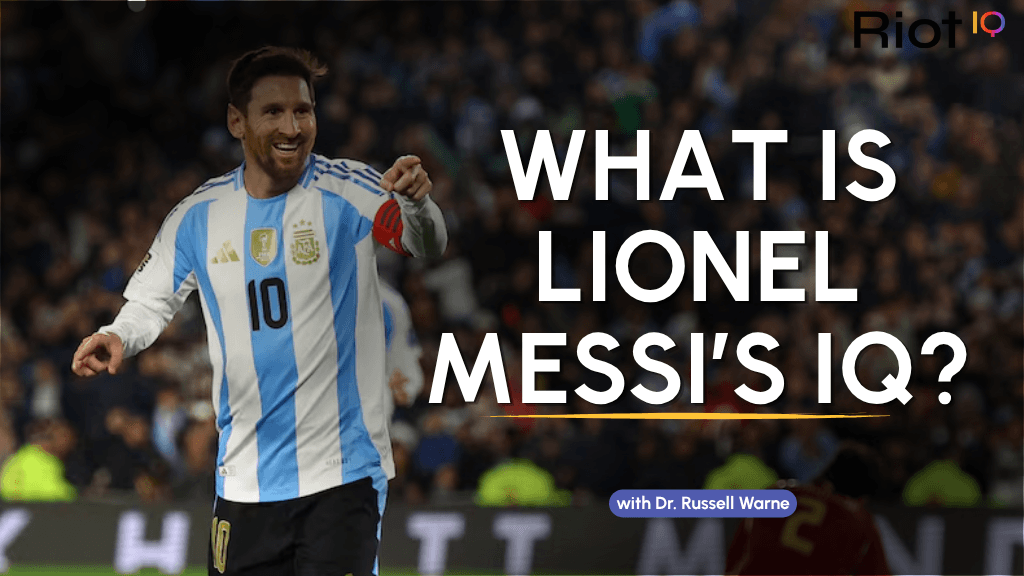
On June 16, 2026, at Kansas City Stadium, Lionel Messi, 38 years old, carrying a hamstring injury, playing in what is almost certainly his final World Cup, scored a hat-trick against Algeria in Argentina's 3-0 group stage opener to tie Miroslav Klose's all-time World Cup scoring record at 16 goals. He then broke it four days later against Austria, becoming the sole all-time leading scorer in men's World Cup history at 18 goals across six tournaments. Klose himself had predicted it: "I expect my record to fall in this tournament. Messi is a genius."
The word "genius" follows Messi everywhere. So does the question that inevitably trails it: what does science actually say about his intelligence? I want to give that question the honest treatment it deserves because the answer involves real cognitive research, real psychometric nuance, and a fair amount of myth that needs clearing out.
What We Don't Know: The Fabricated Numbers
Let me start with what I can say with confidence as a psychometrician: no verified, publicly documented IQ score exists for Lionel Messi. There is no record of him taking an IQ test. None. The figures that circulate online (190, 191, 134, 135) are either fabricated, generated by unvalidated online tools, or extrapolated from behavioral observation with no psychometric basis. Messi's exact IQ score has never been publicly disclosed, and any specific figure attributed to him in popular media should be treated as speculation, not data. An IQ of 190 or 191, which appears on several celebrity IQ websites, would place Messi in a range that essentially doesn't exist in the normative population; scores above 160 are so rare that most professional batteries can't measure them reliably, and no standardized test administered under controlled conditions has ever been linked to those numbers for Messi. While experts estimate his IQ to be between 130 and 150 based on behavioral inference, these figures are not derived from actual psychometric testing and should be read as educated speculation at best.
This matters because treating fabricated celebrity IQ numbers as real data is exactly the kind of misuse of psychometric concepts that erodes public understanding of what IQ tests actually measure. What we can do and what is genuinely more interesting is look at what the research says about the cognitive profile that Messi's performance implies.
What the Research Does Tell Us
The most rigorous recent work on the cognitive profile of elite footballers comes from a landmark 2025 study published in the Proceedings of the National Academy of Sciences, produced by researchers across Oxford, Aarhus, Bologna, Australia, Rio de Janeiro State University, and Karolinska Institute. Using artificial neural networks applied to 204 elite soccer players from top divisions in Brazil and Sweden, the study found that elite players demonstrate heightened planning and memory capacities, enhanced executive functions especially cognitive flexibility, and were distinguishable from the general population with 97% accuracy based on cognitive and personality features alone. Messi isn't merely a member of that elite cohort. He sits at its extreme upper end by every observable metric. Spanish cognitive expert Antonio Martínez-Piqueras has described Messi as possessing multiple cognitive abilities combined, noting that "like people with highly gifted capacities, he changes the environment in which he intervenes." Martínez-Piqueras and many in his profession consider Messi to be a genius, citing his meticulous play design and calculation-based decisions.
The research framework that best explains what Messi is doing cognitively centers on executive functions rather than on IQ in the traditional psychometric sense. A landmark study found that elite soccer players who perform at national team level significantly outperform premier league-level players on executive function tests, and that these scores predict the number of goals and assists made two seasons later, even when controlling for general cognitive ability. In other words: the cognitive abilities that predict Messi-level football performance are meaningfully distinct from, though partially overlapping with, what a standard IQ test measures.
What Messi's Brain Is Actually Doing
A 2016 paper by Jafari and Smith proposed one of the more interesting hypotheses in the football neuroscience literature. They hypothesized that Messi has acquired higher motor skills than most other players, and that this frees up significant cognitive capacity that other players must spend on motor execution, effectively giving him more available working memory to dedicate to reading the game in real time while the physical execution runs on near-automatic processing.
This hypothesis is consistent with what cognitive science tells us about expert performance more broadly. When a skill becomes sufficiently automatized, it demands far less of the limited resource pool of working memory. For Messi, dribbling at pace through three defenders appears to require a fraction of the cognitive effort it demands from a less skilled player, leaving his attentional resources free to simultaneously map teammate positions, anticipate defensive movements, and select an action from several viable options.
Football players must follow the position of teammates and opponents, anticipate trajectories, and make quick decisions while performing complex motor actions, which are demands that heavily rely on cognitive resources such as working memory, attention, and spatial reasoning. Evidence from cognitive neuroscience suggests that brain systems involved in spatial information and decision-making are highly plastic and sensitive to task demands, with regions such as the hippocampus and entorhinal cortex supporting spatial mapping and route simulation. For Messi, decades of exposure to elite-level spatial complexity appears to have refined those systems to an exceptional degree.
His exceptional peripheral vision allows him to anticipate defenders' movements and find gaps in the defense with precision, while his exceptional visual processing speed allows him to assess goal-scoring opportunities in milliseconds — combined with superior pattern recognition skills that allow him to anticipate and adapt to opposing team tactics, exploiting weaknesses and creating scoring opportunities in ways that appear intuitive but reflect rapid, high-load cognitive computation.
The Reactive Cognition Hypothesis
One of the more compelling recent analyses of Messi's cognitive style frames his decision-making as fundamentally reactive rather than pre-planned. Heat map and passing data across his career show that his positioning varies dramatically between matches, not because of tactical instruction, but because he reads defensive structures in real time and gravitates toward space instinctively. His pass completion rates remain remarkably consistent whether operating from the right wing, false nine position, or deep midfield playmaker role — evidence that his spatial processing adapts fluidly rather than relying on rehearsed patterns tied to a single position.
This reactive cognitive profile is significant because it describes something different from what IQ tests primarily assess. Standard IQ batteries sample reasoning under standardized, rule-governed conditions with predetermined correct answers. What Messi demonstrates is something more akin to what researchers call naturalistic decision-making under uncertainty — a form of expert cognition that depends on pattern recognition built from massive domain-specific experience rather than on abstract reasoning in novel, context-free conditions.
A 2024 general model of cognition in elite soccer published in Frontiers in Psychology identified three functional stages underlying each play situation: situational assessment, action selection and execution, and outcome assessment. Skilled soccer players consistently outperform less skilled players on anticipation tasks, and more skilled players anticipate significantly quicker, are better at anticipating deceptive moves, and generate more complex verbal statements about their own thought processes during anticipation. Messi operates at the extreme end of all three dimensions simultaneously.
Where IQ and Football Intelligence Overlap and Where They Don't
The distinction I want to draw here is not that Messi is unintelligent — there is no evidence for that and considerable evidence against it. The distinction is between general intelligence as measured by a standardized battery and domain-specific cognitive excellence as demonstrated by elite performance in a complex, dynamic environment.
Executive functions correlate with each other but correlate less with general IQ — meaning that someone's working memory, cognitive flexibility, and inhibitory control can be substantially above average even when performance on traditional IQ subtests is not exceptional, and vice versa. Messi's documented cognitive profile almost certainly places him well above average across multiple executive function domains, and his performance on fluid reasoning tasks — the ability to solve novel problems under time pressure without relying on stored knowledge — likely reflects the same. But extrapolating from that to a specific IQ number, particularly the extraordinary figures that circulate online, goes beyond what the evidence supports.
What the evidence does support is this: Messi's football performance reflects a genuine cognitive profile that is measurably distinct from the general population, involves executive function capacities that standard IQ tests partially but incompletely capture, and has been refined by a lifetime of high-complexity spatial experience in a way that few humans ever achieve.
What This World Cup Performance Tells Us
At 38, having already broken the all-time World Cup scoring record across his sixth tournament appearance, Messi is demonstrating something that the cognitive aging literature would classify as the crystallized end of the intelligence spectrum, accumulated expertise so deeply encoded that it runs efficiently even as raw processing speed would be expected to decline with age. The players who rely primarily on speed and reaction time show measurable decline through their late 30s. Players whose game is built on anticipation, positioning, and spatial pattern recognition, the cognitive dimensions that define Messi's game, tend to maintain their effectiveness considerably longer. That's not an accident. It's what the research on fluid versus crystallized cognition, on expert automatization, and on executive function development in elite athletes all converge on predicting.
The Takeaway
Lionel Messi's IQ score is unknown. The numbers circulating online have no verified psychometric basis and should be treated as the internet mythology they are. What is documented, through peer-reviewed research and observable performance, is that Messi possesses a cognitive profile that places him at the extreme end of the abilities most directly relevant to elite football: spatial reasoning, executive function, working memory under pressure, anticipatory pattern recognition, and the kind of motor automatization that frees up cognitive resources for real-time game-reading.
Whether that translates to a specific IQ number is a question the existing research cannot answer — and one that a serious psychometrician would resist speculating about without actual test data. What it does translate to is a level of domain-specific cognitive excellence that the science of intelligence increasingly recognizes as real, measurable, and distinct from what any single test score can fully capture.
References
Real IQ Test Online. (2024). Lionel Messi IQ Score. https://realiqtestonline.com/celebrity-iq/messi-iq/ PubMed Central / PNAS. (2025). Decoding the elite soccer player's psychological profile. https://pmc.ncbi.nlm.nih.gov/articles/PMC11760505/ Nature / Scientific Reports. (2020). Level of play and coach-rated game intelligence are related to performance on design fluency in elite soccer players. https://www.nature.com/articles/s41598-020-66180-w Frontiers in Sports and Active Living / PubMed Central. (2025). Training spatial intelligence in football through the cognitive load scale. https://pmc.ncbi.nlm.nih.gov/articles/PMC12376292/
Take our professional IQ test
Want to know your IQ? Try the first ever professional online IQ test.
AuthorDr. Russell T. WarneChief Scientist
