Jun 17, 2026·Taking an IQ TestA Beginner's Guide to IQ Testing
What is intelligence and how is IQ calculated? Learn the history, science, and true meaning of your score. Read our complete guide and try the RIOT test!
Dr. Russell T. WarneChief Scientist
Most people have heard of IQ tests, but few have a clear sense of what they actually measure, how the scores are calculated, or what the results can tell us about a person. This guide is designed to answer those questions plainly and accurately — without the myths that tend to surround the topic. IQ testing is not a single test or a fixed set of questions. It is a scientific tradition over 120 years old, built on careful research into what intelligence is and how to measure it reliably. Understanding the basics makes it far easier to interpret scores, evaluate tests, and avoid the many misconceptions that circulate about intelligence testing.
What is intelligence?
Before discussing IQ, it is worth being precise about what intelligence actually is. In 1997, a consensus statement signed by over 50 leading intelligence researchers defined intelligence as "a very general mental capability that, among other things, involves the ability to reason, plan, solve problems, think abstractly, comprehend complex ideas, learn quickly, and learn from experience." That definition reflects genuine scientific consensus, not opinion. Intelligence is not the same as knowledge, creativity, or technical expertise. A person can be highly knowledgeable in a narrow field and have average general intelligence. Conversely, a highly intelligent person may know very little about a subject they have never studied. Intelligence is the underlying capacity to learn, reason, and solve problems — not the accumulated product of those abilities. IQ is the numeric score produced by a test designed to measure that capacity. The two terms are not interchangeable.
Two other concepts are worth distinguishing from intelligence at the outset. Emotional intelligence and practical intelligence have both attracted popular attention, but neither has found the scientific footing of general intelligence. The evidence for general intelligence — and its measurability — is among the strongest in all of psychology.
What is IQ, and how is it calculated?
"IQ" stands for "intelligence quotient," a term with a specific historical origin. When the first intelligence tests were developed in the early 20th century, German psychologist Wilhelm Stern proposed calculating scores using the ratio of mental age to chronological age, multiplied by 100. A child whose performance matched that of someone two years older would have an IQ above 100; a child performing at the level of a younger child would have an IQ below 100.
This formula is long outdated. Today, every major IQ test uses what is called a "deviation IQ." Rather than comparing a person to children of different ages, deviation IQs compare a test taker's performance to others in the same age group. The score reflects how far above or below the average a person falls, expressed in standard deviation units. The scale is then converted so that the average becomes 100 and one standard deviation equals 15 points. A person who scores exactly at the mean for their age group receives an IQ of 100. A person one standard deviation above average receives a 115. Two standard deviations above average equals 130.
The math is worth understanding because it clarifies what an IQ score actually means: it is a relative measure, not an absolute one. An IQ of 130 does not mean someone knows twice as much as someone with an IQ of 65 — it means they performed substantially better than average on a test designed to measure cognitive ability, relative to their peers.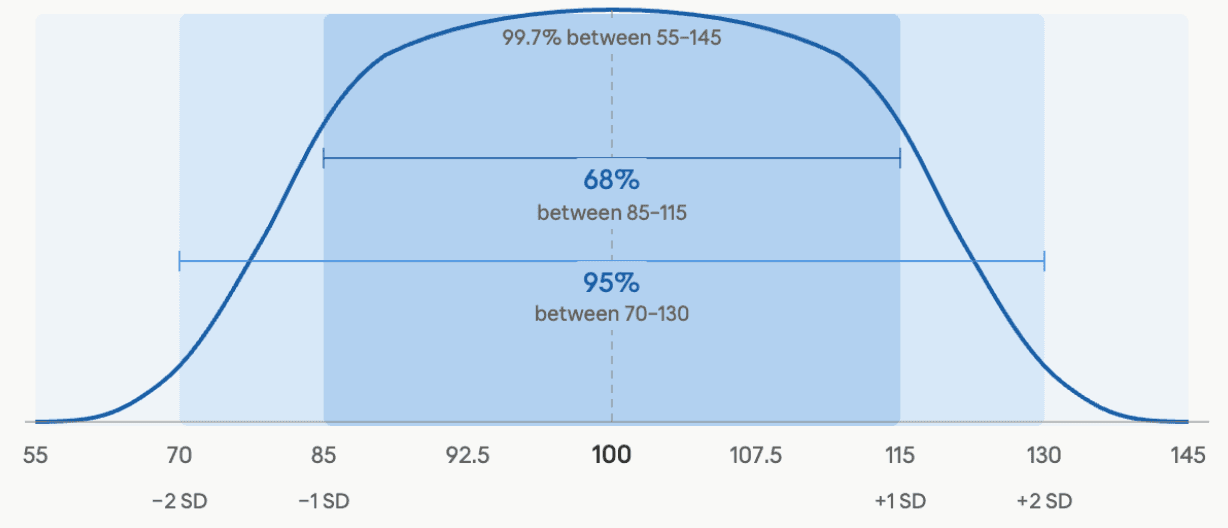
A brief history of IQ testing
The first successful intelligence test was published in 1905 by Alfred Binet and Theodore Simon in Paris. Their goal was practical: to identify children who might struggle in regular classrooms and who would benefit from special education. The test was not designed as a ranking system for the general population — it was a diagnostic tool created out of educational necessity.
The Binet-Simon test spread rapidly. Stanford University professor Lewis Terman adapted and expanded it into the Stanford-Binet, the first widely used IQ test for American children, published in 1916. Terman also contributed to a landmark development in IQ testing: the first group-administered intelligence tests. Working with the U.S. Army during World War I, Terman and a committee of psychologists created the Army Alpha (for literate recruits) and Army Beta (for those with limited literacy). More than two million tests were administered before the war ended.
These Army tests proved something important: intelligence could be measured efficiently at scale, and the scores predicted meaningful outcomes — training success, military rank, and job performance. That practical validation drove the expansion of IQ testing throughout the 20th century.
David Wechsler introduced a series of intelligence tests beginning in 1939 that became, and remain, the most widely used IQ tests in the world. Wechsler also introduced the deviation IQ — the scoring system described above — which replaced the outdated quotient formula. Modern tests, including group-administered and online versions, continue in this tradition.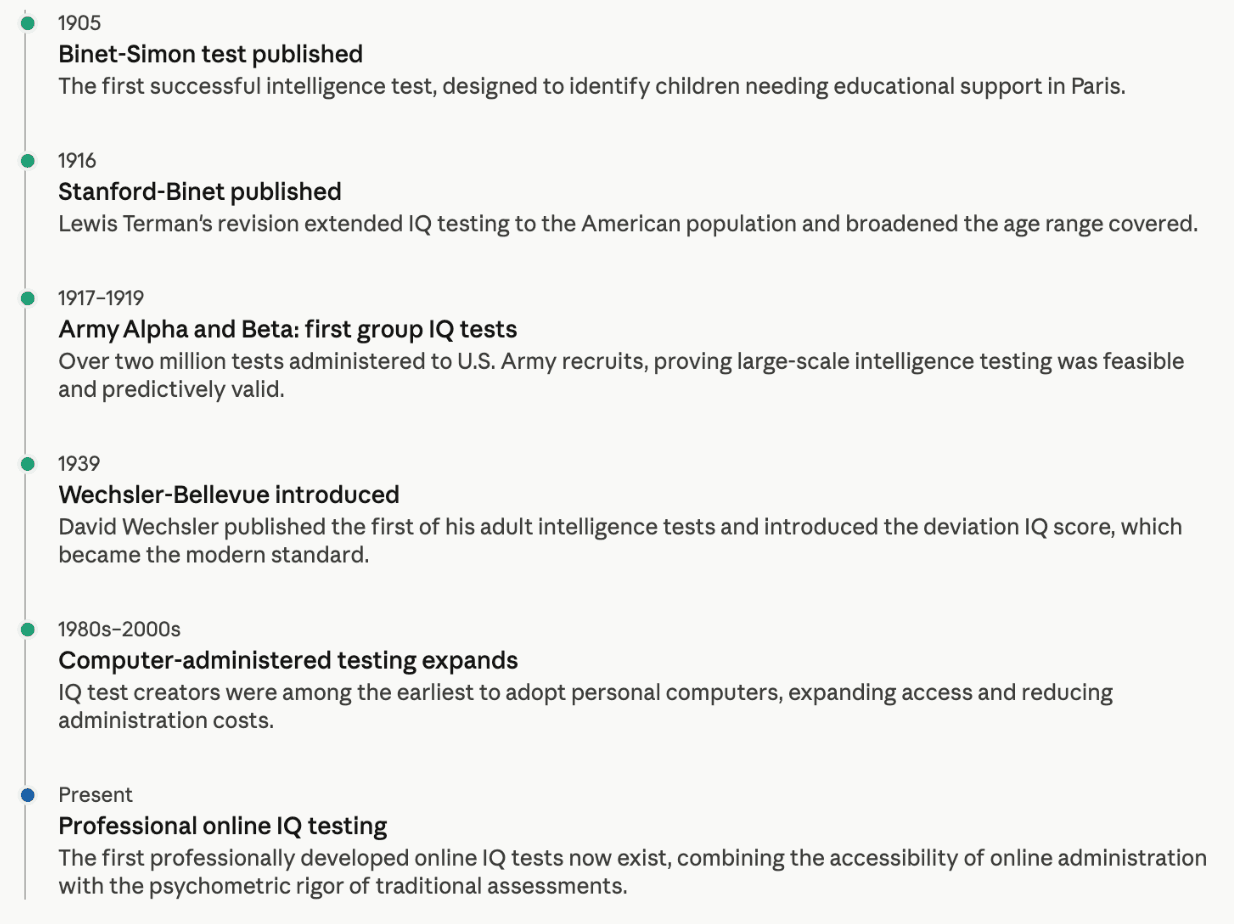
What do IQ tests measure?
IQ tests are not all identical. Different tests use different tasks, different question formats, and different theoretical frameworks. Despite this variety, all IQ tests measure overlapping cognitive abilities, and that convergence is not accidental.
The most influential contemporary framework for understanding what IQ tests measure is the Cattell-Horn-Carroll (CHC) theory of intelligence. CHC theory organizes cognitive abilities into a hierarchy: at the top sits general intelligence (g), a broad factor that underlies performance across all types of cognitive tasks. Below g are "broad" abilities, such as fluid reasoning, crystallized intelligence (accumulated verbal knowledge), processing speed, working memory, and spatial ability. Below those are narrow, specific abilities.
This hierarchy explains why a comprehensive IQ test reports both a global IQ score and several index or subscale scores. The global score reflects g. The index scores reflect the broad abilities. Together, they provide a more complete picture of a person's cognitive profile than either the global score or the subscores alone could offer.
One of the most consistent findings in intelligence research is that performance on any cognitive task tends to correlate positively with performance on any other cognitive task requiring thinking or reasoning. A person who scores well on a vocabulary test tends to score well on spatial puzzles, and also tends to score well on tests of working memory. This pattern — called the "positive manifold" — is why g exists and why general intelligence can be meaningfully measured with such diverse types of tasks.
How are IQ scores calculated?
Understanding the mechanics of IQ scoring prevents a great deal of confusion. A raw score — the number of questions answered correctly — means very little in isolation. To be useful, it must be compared to a reference group.
Every professionally developed IQ test is administered to a large, carefully selected sample called the "norm sample" before it is released to the public. The norm sample is intended to represent the population for which the test is designed. For a test normed on the U.S. population, the norm sample should include people from diverse geographic regions, educational backgrounds, and demographic groups in proportions that match the actual U.S. population. A norm sample that overrepresents highly educated or highly motivated individuals will make a typical person's score look lower than it should be.
Once the norm sample data is collected, the raw scores are transformed into a scale with an average of 100 and a standard deviation of 15. When a new test taker receives their IQ score, that score reflects their position relative to the norm sample — specifically, how many standard deviations above or below the mean they scored.
IQ scores should also be accompanied by a confidence interval — a range that reflects the inherent uncertainty in any single score. No test is perfectly precise. A score of 112 might represent true intelligence anywhere from 106 to 118, depending on the test's reliability. Professional test reports communicate this uncertainty explicitly.
Types of IQ tests
There are many IQ tests in existence, and classifying them helps clarify what different tests are designed to do.
The broadest distinction is between individually administered tests and group-administered tests. Individually administered tests — such as the Wechsler Adult Intelligence Scale (WAIS), the Stanford-Binet, and the Woodcock-Johnson — are given one-on-one by a trained psychologist or clinician. They allow the examiner to observe the test taker directly, adapt the session as needed, and administer complex tasks that require verbal responses or hands-on materials. These tests are the gold standard for clinical and forensic use.
Group-administered tests are given to multiple people simultaneously and are common in educational and employment settings. Many such tests are now computer-based, though paper-and-pencil formats still exist. The tradeoff is efficiency: group tests can assess many people quickly, but they cannot offer the flexibility or depth of individual administration.
Online IQ tests are a newer category. Online testing eliminates geographic barriers and reduces cost significantly. The critical variable is not whether a test is online — it is whether the test was developed by qualified professionals using appropriate psychometric methods. Online delivery is simply a method of administration; it does not, by itself, determine whether a test is trustworthy or valid.
A second distinction is between IQ test batteries and single-format tests. IQ test batteries consist of multiple subtests, each measuring a different aspect of cognition. A battery might include tasks assessing verbal reasoning, spatial ability, working memory, and processing speed. Because no single task perfectly captures intelligence, batteries that sample a broad range of cognitive abilities produce more comprehensive and reliable scores. Single-format tests — such as the Raven's Progressive Matrices, which uses only matrix reasoning items — are simpler to administer but measure a narrower slice of cognitive ability.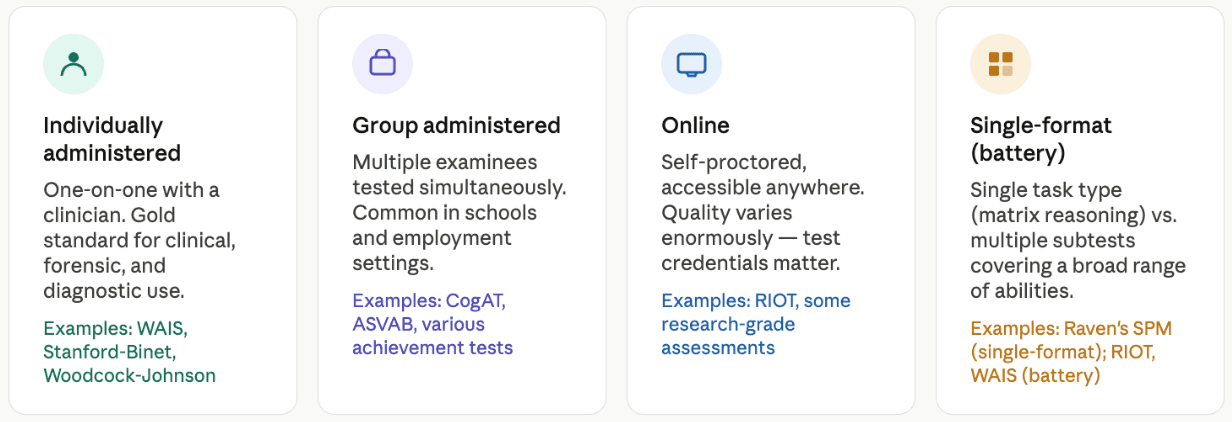
What do IQ scores predict?
This question has a clear and well-researched answer. IQ is one of the most extensively validated predictors in all of social science. It predicts outcomes in school, in the workplace, and in health — not perfectly, but with enough consistency to be scientifically meaningful and practically useful.
In educational settings, research consistently shows correlations between IQ scores and academic performance ranging from r = .40 to .81, depending on the method of measurement. The WISC-IV Full Scale IQ, for instance, explains about 60% of the variance in concurrent standardized achievement test scores. That is a strong relationship by any standard in psychological research. In workplace settings, a landmark meta-analysis by Schmidt and Hunter found that general mental ability is the single best predictor of job training success and overall job performance across occupations. The predictive validity coefficients ranged from about .30 for low-complexity jobs to over .50 for high-complexity positions. For cognitively demanding jobs — medicine, law, engineering, research — intelligence is not just one predictor among many. It is the dominant one. Beyond school and work, IQ correlates with health outcomes, longevity, economic security, and crime rates. People with higher IQs tend to make better health decisions, navigate complex systems more effectively, and achieve greater financial stability. These are probabilistic tendencies, not guarantees — and IQ is rarely the only factor in any of these outcomes. In educational settings, combining IQ scores with prior academic performance improves predictions beyond what either variable provides alone. In employment, cognitive ability works best when combined with measures of conscientiousness and job-relevant knowledge. IQ opens doors — it does not walk through them on anyone's behalf.
What makes an IQ test trustworthy?
Not all IQ tests are equally credible. The proliferation of online tests has made this an especially important question for anyone considering taking one. The checklist below describes the characteristics that distinguish a professionally developed IQ test from amateur efforts. If a test cannot demonstrate most of these qualities, the scores it produces should not be trusted.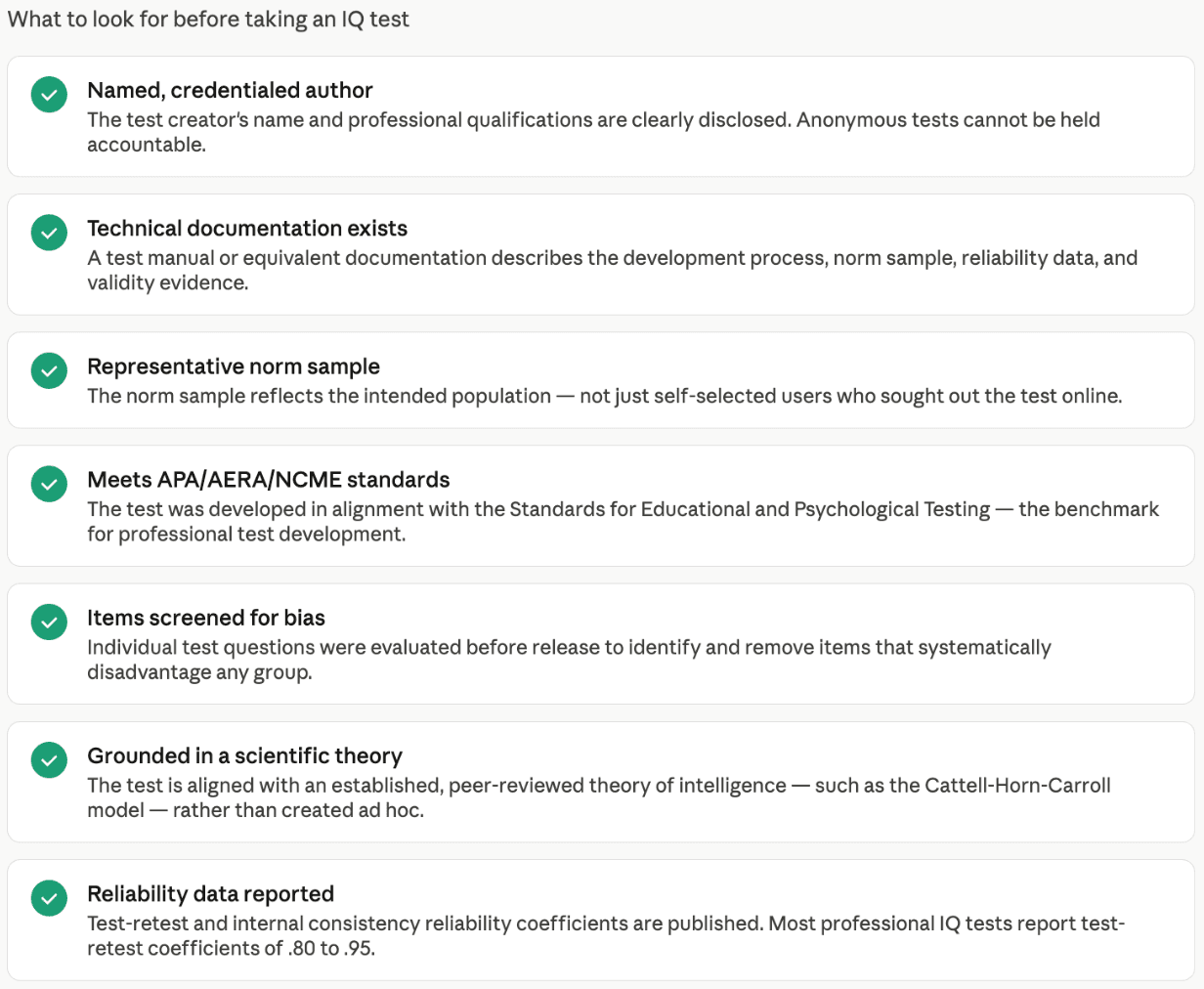
Understanding IQ score ranges
IQ tests have used named ranges to give verbal meaning to the numbers since testing began. The labels have changed over time — what was once called "borderline" is now called "very low" on the Wechsler scales — which should make clear that the labels are conventions, not scientific facts. The scores themselves carry the meaning; the labels just translate them into language.
A few benchmarks are worth keeping in mind. An IQ of 100 is, by definition, the average. About two-thirds of the population scores between 85 and 115. A score around 70 to 75 marks the lower threshold typically used in the diagnosis of intellectual disability. Professional jobs requiring advanced education generally expect a minimum IQ of around 110. Higher scores are associated, on average, with better life outcomes.
Common misconceptions about IQ
Several widely held beliefs about IQ are either false or significantly overstated.
IQ is not fixed for life. IQ scores are influenced by environmental factors, including education, nutrition, and early childhood experiences. That said, intelligence is also substantially heritable, and the environmental factors that raise IQ most reliably — schooling and stable home environments — are already common in wealthy countries. The practical implication is that IQ is fairly stable throughout most of adult life, not that it cannot change at all.
The Flynn effect does not mean people are getting smarter. Throughout the 20th century, average IQ scores rose by about three points per decade across many countries. But this rise operated on the non-g components of IQ — the specific skills and familiarity with test-like tasks that society trains people in over time. General intelligence (g) did not increase at this rate. The Flynn effect reflects changes in what people are practiced at, not improvements in underlying cognitive capacity. A score is a measurement, not the thing being measured. Just as a thermometer measures heat without being heat itself, an IQ score is the metric used to quantify intelligence — not intelligence itself. Achieving a higher score through test-taking strategies or repeated practice ("hollow gains") raises the number without raising the underlying ability.
Group differences in IQ do not indicate test bias. Average IQ differences across demographic groups are real and documented. But the existence of group differences is not, by itself, evidence of bias. Test bias exists only when a test systematically advantages or disadvantages one group for reasons unrelated to the ability being measured. Modern professionally developed IQ tests are routinely screened for bias before release, and the research literature has consistently found that well-constructed tests perform similarly across groups for whom they were designed. Gardner's theory of multiple intelligences is not a scientifically validated alternative. This theory proposed that intelligence consists of seven or more independent intelligences, but it has found little support in research. The central claim — that the intelligences are independent of one another — is contradicted by decades of data showing that performance on different cognitive tasks always correlates positively. Scientists have called it a "neuromyth" — an appealing idea that does not hold up under scientific scrutiny.
Where IQ tests are used
IQ tests are used in a wide range of professional settings, and understanding these uses helps clarify what IQ scores are actually good for.
In schools, psychologists use IQ tests as part of the process of identifying learning disabilities, qualifying students for gifted programs, and understanding a child's overall cognitive profile. The IQ test is rarely a standalone diagnostic tool; it is one component of a larger assessment process that often includes other tests, teacher and parent reports, and academic records.
In employment, IQ testing is most prominent in the military. The Armed Services Vocational Aptitude Battery (ASVAB) functions as an intelligence test and is used to identify recruits suited for different roles. Civilian employers also use cognitive ability tests, particularly for technical and managerial positions where cognitive demands are high.
In clinical and forensic settings, psychologists administer IQ tests to understand a client's cognitive functioning, to inform treatment planning, to evaluate competency to stand trial, and to make determinations about intellectual disability in legal proceedings. The stakes in these contexts can be very high, which is precisely why the quality of the test being used matters enormously.
In research, IQ scores are used in thousands of studies every year. The extensive body of research on intelligence has made it one of the best-understood individual difference variables in all of psychology. That research base is also what makes IQ testing credible — not institutional authority or tradition, but decades of empirical findings from independent investigators around the world.
Taking the first professional online IQ test
For most of IQ testing's history, a professional assessment required scheduling an appointment with a psychologist and spending several hours in a clinical setting. That is still the appropriate path for clinical or forensic evaluations. But for individuals who want a reliable, research-grade measure of their general intelligence outside of those contexts, another option now exists.
The Reasoning and Intelligence Online Test (RIOT) is the first online IQ test developed to meet the same professional standards as traditional in-person assessments. I created it after 15 years of research in intelligence and psychological testing, drawing on that work to build a test aligned with the Cattell-Horn-Carroll model — the dominant theoretical framework in the field. The RIOT was normed on a representative U.S. sample and its items were reviewed by a panel of experts from cognitive, educational, and developmental psychology, and screened for bias before release. Its development followed the Standards for Educational and Psychological Testing established by the APA, AERA, and NCME. The test covers the full range of abilities measured by professional IQ batteries: verbal reasoning, fluid reasoning, spatial ability, working memory, processing speed, and reaction time. Examinees receive an overall IQ score along with detailed index scores and a report explaining what the results mean.
Online testing does not have to mean lower quality. The key is whether the test was built by professionals who understand what it takes to produce reliable, valid, and fair scores.
Sources cited
Gottfredson, L. S. (1997). Mainstream science on intelligence: An editorial with 52 signatories, history, and bibliography. Intelligence, 24, 13–23. https://doi.org/10.1016/S0160-2896(97)90011-8 Roth, B., et al. (2015). Intelligence and school grades. Intelligence, 53, 118–137. https://www.ncbi.nlm.nih.gov/pmc/articles/PMC5346574/ Schmidt, F. L., & Hunter, J. E. (1998). The validity and utility of selection methods in personnel psychology. Psychological Bulletin, 124(2), 262–274. https://doi.org/10.1037/0033-2909.124.2.262 Deary, I. J., et al. (2009). Association between IQ in adolescence and a range of health outcomes at 40. Intelligence, 37(6), 573–580. https://www.ncbi.nlm.nih.gov/pmc/articles/PMC2772900/ Flynn, J. R. (2004). IQ gains, WISC subtests and fluid g. Intelligence, 32(5), 469–480. https://doi.org/10.1016/j.intell.2004.07.002 Warne, R. T. (2025). Technical manual for the Reasoning and Intelligence Online Test, version 1.0. RIOT IQ.
Waterhouse, L. (2023). Why multiple intelligences theory is a neuromyth. Frontiers in Psychology, 14. https://doi.org/10.3389/fpsyg.2023.1217288 Kaufman, S. B., et al. (2012). Are cognitive g and academic achievement g one and the same? Intelligence, 40(6), 535–545. https://doi.org/10.1016/j.intell.2010.07.002 Reynolds, C. R., & Lowe, P. A. (2009). The problem of bias in psychological assessment. In T. B. Gutkin & C. R. Reynolds (Eds.), The handbook of school psychology. Wiley. https://doi.org/10.1037/a0036503 AERA, APA, & NCME. (2014). Standards for educational and psychological testing. https://www.testingstandards.net/ Warne, R. T. (2020). In the know: Debunking 35 myths about human intelligence. Cambridge University Press. https://doi.org/10.1017/9781108593298 Ritchie, S. J., & Tucker-Drob, E. M. (2018). How much does education improve intelligence? Psychological Science, 29(8), 1358–1369. https://doi.org/10.1177/0956797618774253 Deary, I. J., et al. (2010). The neuroscience of human intelligence differences. Nature Reviews Neuroscience, 11, 201–211. https://doi.org/10.1016/j.neubiorev.2018.08.013
Take our professional IQ test
Want to know your IQ? Try the first ever professional online IQ test.
AuthorDr. Russell T. WarneChief Scientist
