Jun 23, 2026·Taking an IQ TestWhen Is the Right Time to Take an IQ Test?
Why do IQ scores matter? Discover how cognitive testing predicts academic, career, and health outcomes. Read the full article and try the RIOT test today!
Dr. Russell T. WarneChief Scientist
One of the questions I hear most often is not about what IQ tests measure or why they matter, but about timing: when should a person actually take one? The answer depends on why the test is being taken, the age of the examinee, and what kind of decision the results are meant to inform. Getting the timing right matters because cognitive abilities follow predictable developmental trajectories, and a test administered at the wrong moment can produce results that are less informative — or even misleading. This article explains what the research says about when IQ testing is most useful and when it makes sense to wait.
How Stable Are IQ Scores Across the Lifespan?
The first thing to understand about IQ test timing is that IQ scores are remarkably stable over time — but the degree of stability depends on the age at which the test is first administered.
A comprehensive 2024 meta-analysis by Breit, Scherrer, Tucker-Drob, and Preckel (Psychological Bulletin), drawing on 205 longitudinal studies and over 87,000 participants, found that rank-order stability of cognitive ability increases sharply during childhood, reaching high levels by late adolescence and remaining there throughout adulthood. For a 20-year-old tested and then retested five years later, the average stability correlation was ρ = .76 at the observed level. After correcting for test measurement error, the estimate rose to ρ = .86. In other words, a person's relative position among their peers in cognitive ability is largely established by early adulthood and changes very little after that. This does not mean that raw cognitive performance stays the same forever. Different abilities follow different trajectories. Processing speed peaks in the late teens to early twenties and declines steadily from there. Fluid reasoning — the ability to solve novel problems without relying on prior knowledge — peaks in the mid-twenties and declines more gradually. Crystallized intelligence — accumulated knowledge, vocabulary, and verbal skills — continues to grow through middle adulthood and does not begin to decline until the mid-to-late seventies in most people. The Seattle Longitudinal Study, spanning over six decades of data collection, confirmed that verbal comprehension and knowledge remain stable well into later life, while reasoning, spatial orientation, and speed decline after about age 60 (Schaie, 2005). Because deviation IQ scores compare a person to others in their own age group, these developmental changes are already accounted for. A 65-year-old who scores 115 on an IQ test is being compared to other 65-year-olds, not to 25-year-olds. This is one of the reasons IQ scores remain interpretable at any adult age.
When Is IQ Testing Most Reliable in Children?
IQ scores are least stable in very young children. The Breit et al. (2024) meta-analysis found that stability sufficient for individual-level diagnostic decisions (a test-retest correlation of .80 or higher) can only be expected after about age 7, and only for relatively short intervals between tests. Before that age, there is too much developmental variability for a single test to anchor firm conclusions about a child's long-term cognitive trajectory.
This does not mean that IQ testing in early childhood is useless. For children with significant developmental delays, testing as early as age 3 or 4 can identify the need for early intervention services, and the earlier those services begin, the more effective they tend to be. But for questions about giftedness, long-term academic placement, or whether a child is suited for a particular educational path, testing before age 6 or 7 produces results that are less predictive of future performance than testing at age 8 or later.
For most educational purposes — identifying learning disabilities, selecting students for gifted programs, or establishing a cognitive baseline — testing between the ages of 6 and 12 offers the best combination of score consistency and practical relevance. By this age range, the major cognitive abilities are sufficiently developed that the test captures meaningful individual differences, and the results are stable enough to support diagnostic and placement decisions.
There is an important caveat: high stability does not mean that children cannot change. It means that, on average, children who score above their peers at age 8 are very likely to remain above their peers at age 15. Individual exceptions exist, and life events (both positive and negative) can shift scores. But the general pattern is one of high consistency once childhood reaches the school-age years.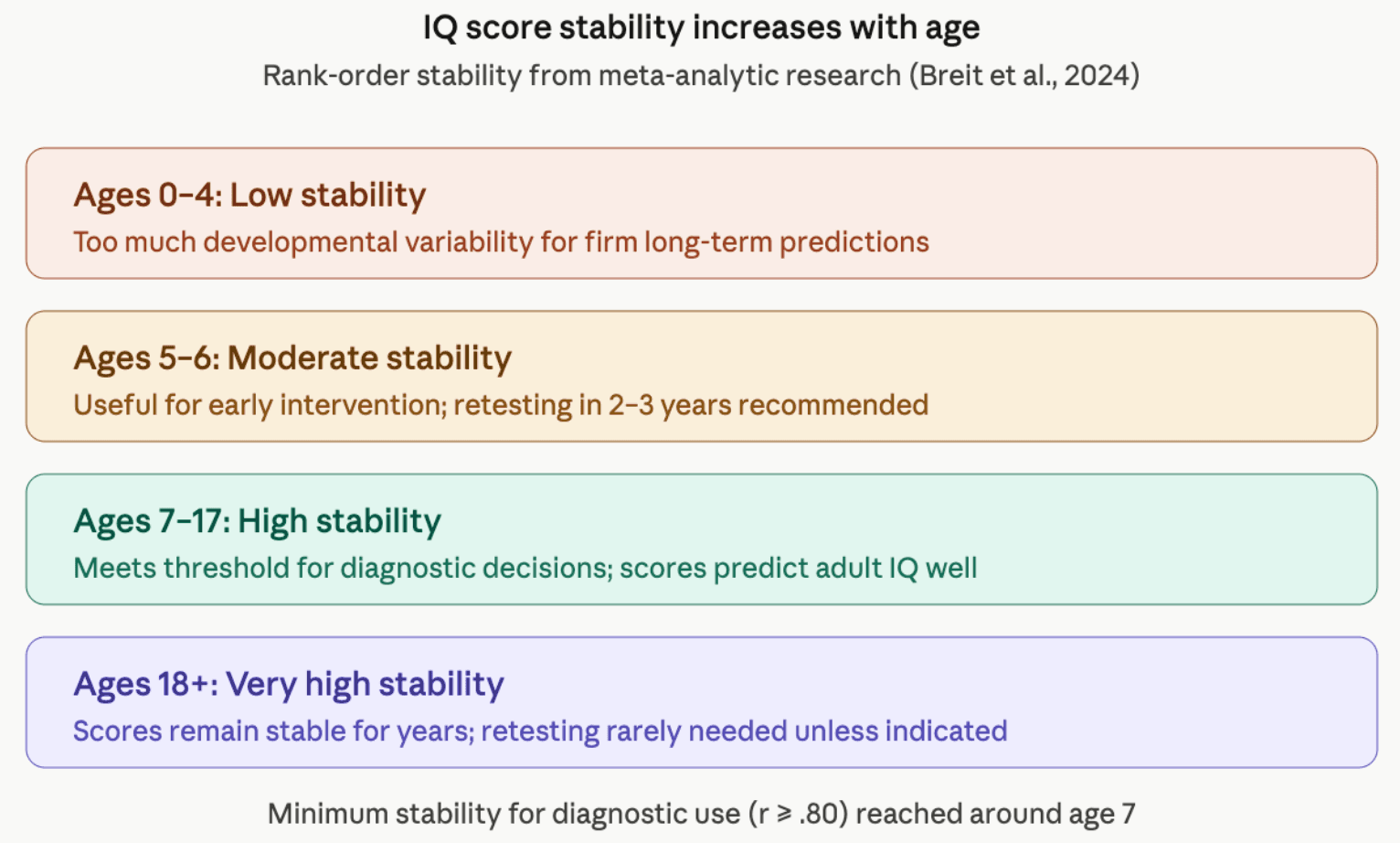
When Should Adults Consider IQ Testing?
For adults, the question of timing is less about developmental readiness and more about circumstance. Because adult IQ scores are highly stable, the right time to take an IQ test is whenever a situation arises that would benefit from cognitive data.
There are several common circumstances. An adult who is entering a clinical evaluation for a suspected cognitive condition — ADHD, a learning disability that was never diagnosed in childhood, or early signs of cognitive decline — benefits from having a current IQ test as part of the assessment. In these cases, the sooner the test is administered, the sooner treatment or accommodations can begin.
Adults considering a career change may find that an IQ test clarifies whether their cognitive profile aligns with the demands of a new field. This is especially valuable when the shift involves moving from a verbally intensive field to one that emphasizes spatial or quantitative reasoning (or vice versa). A person does not need to wait for a crisis to take an IQ test; proactive self-knowledge is a perfectly valid reason.
For adults in their 60s and beyond, IQ testing serves a different function. Because fluid abilities like processing speed and working memory decline with age, a baseline IQ test taken in the early sixties can serve as a reference point for tracking cognitive health over time. If concerns about memory or reasoning arise later, clinicians can compare current performance against the earlier baseline to determine whether the decline exceeds what would be expected for normal aging. Without that baseline, distinguishing between normal age-related changes and early-stage cognitive impairment becomes much more difficult.
When Should a Person Wait Before Taking an IQ Test?
There are several situations where postponing an IQ test is the better choice.
Illness, sleep deprivation, and acute stress all impair cognitive performance. A person who is running a fever, who slept three hours the night before, or who is in the middle of a personal crisis is not going to perform at their best on an IQ test. The resulting score will underestimate their true ability. This is not a flaw of the test — it is measuring cognitive performance at that moment, and that moment happens to be unrepresentative. Waiting until the temporary impairment has passed produces a more accurate result.
Similarly, a person who has recently taken the same IQ test (or a very similar one) should wait before retesting. Practice effects — score increases caused by familiarity with the test format rather than actual cognitive improvement — inflate scores by approximately 5 IQ points on a second administration and about 3 points on a third (Scharfen et al., 2018, Intelligence). Most professional IQ test manuals recommend a minimum interval of one year between administrations, and some recommend longer. If a person has recently taken an IQ test and received professionally administered results, retesting within a few months is unlikely to add useful information.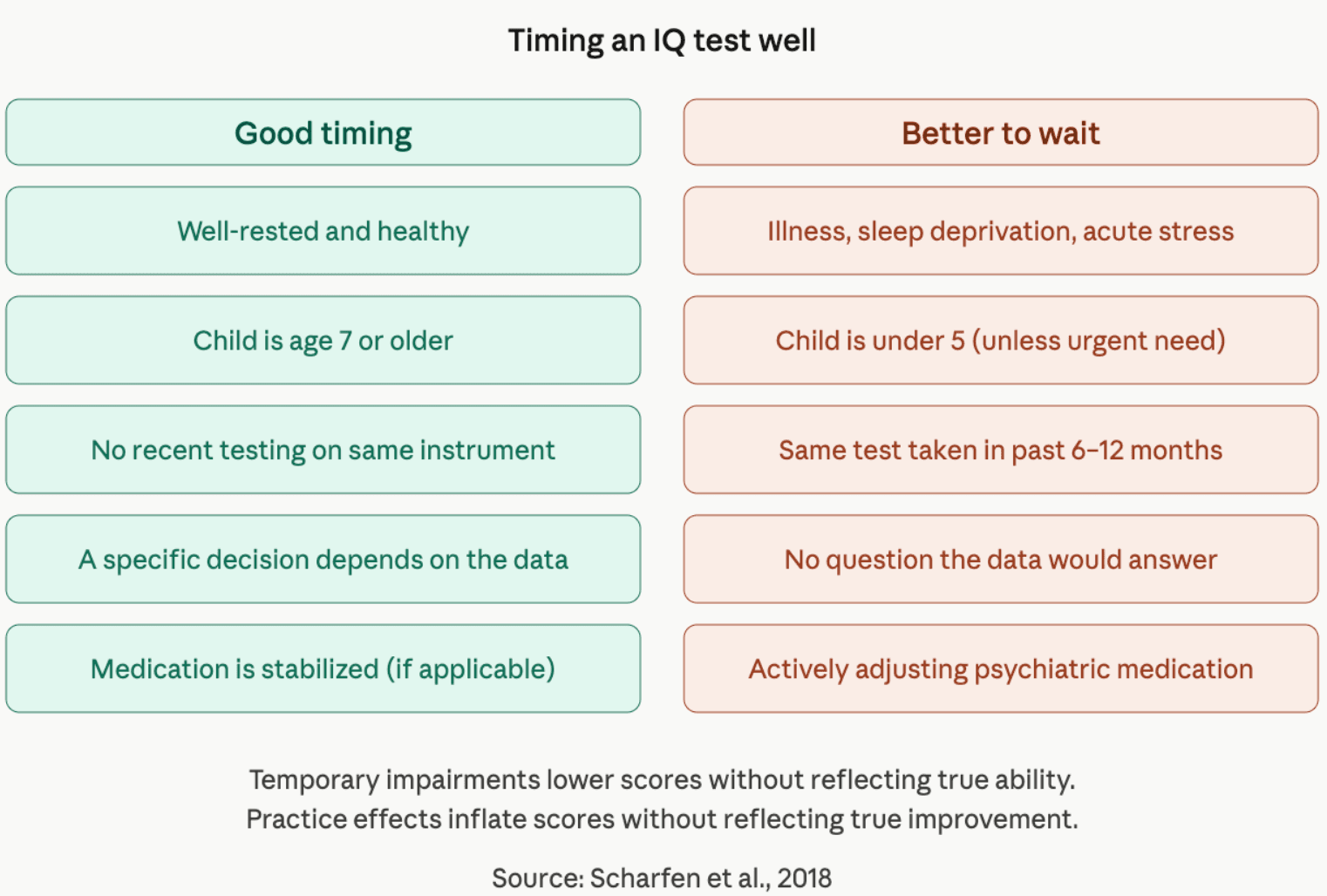 Medication changes can also affect the timing of a useful IQ test. A person who is in the process of adjusting psychiatric medications — particularly stimulants for ADHD, antidepressants, or antipsychotics — may experience temporary cognitive effects that are not representative of their stable functioning. Waiting until the medication regimen has stabilized for at least several weeks produces results that more accurately reflect the person's typical cognitive performance.
Does the Time of Year Matter?
For children who are tested in school settings, the time of year can matter more than most people realize. A child tested at the beginning of the school year, before they have been exposed to the year's curriculum, may perform differently on knowledge-based subtests than a child tested at the end of the year. This effect is modest, and it does not affect fluid reasoning or processing speed subtests (which do not depend on learned content), but it can influence verbal and knowledge-heavy components of an IQ battery.
For adults, the time of year is generally irrelevant to IQ test performance. What matters more is the time of day. Research on cognitive performance consistently shows that most people perform best during their peak alertness hours, which for most adults is mid-morning to early afternoon. Taking an IQ test late at night or after a long day of work is unlikely to produce a best-effort result. Professional test administrators typically schedule assessments during morning or early afternoon hours for exactly this reason.
What About Retesting?
Because IQ scores are so stable in adults, retesting is rarely necessary unless there is a specific clinical reason. The situations that warrant retesting include a suspected change in cognitive functioning (due to brain injury, neurological disease, or significant medical events), a need for updated data for legal or institutional purposes (some schools and courts require recent test results), or a previous test that was administered under conditions that may have compromised the results (illness, extreme anxiety, or an unqualified examiner). In all cases, allowing at least 12 months since the last administration avoids the practice effects described above.
For children, retesting is more common because cognitive development is still underway. A child tested at age 6 may benefit from retesting at age 9 or 10, particularly if the initial results are being used for long-term placement decisions. The same meta-analytic research confirms that while childhood scores are consistent, they are not as fixed as adult scores, and periodic reevaluation ensures that educational decisions remain aligned with the child's current abilities.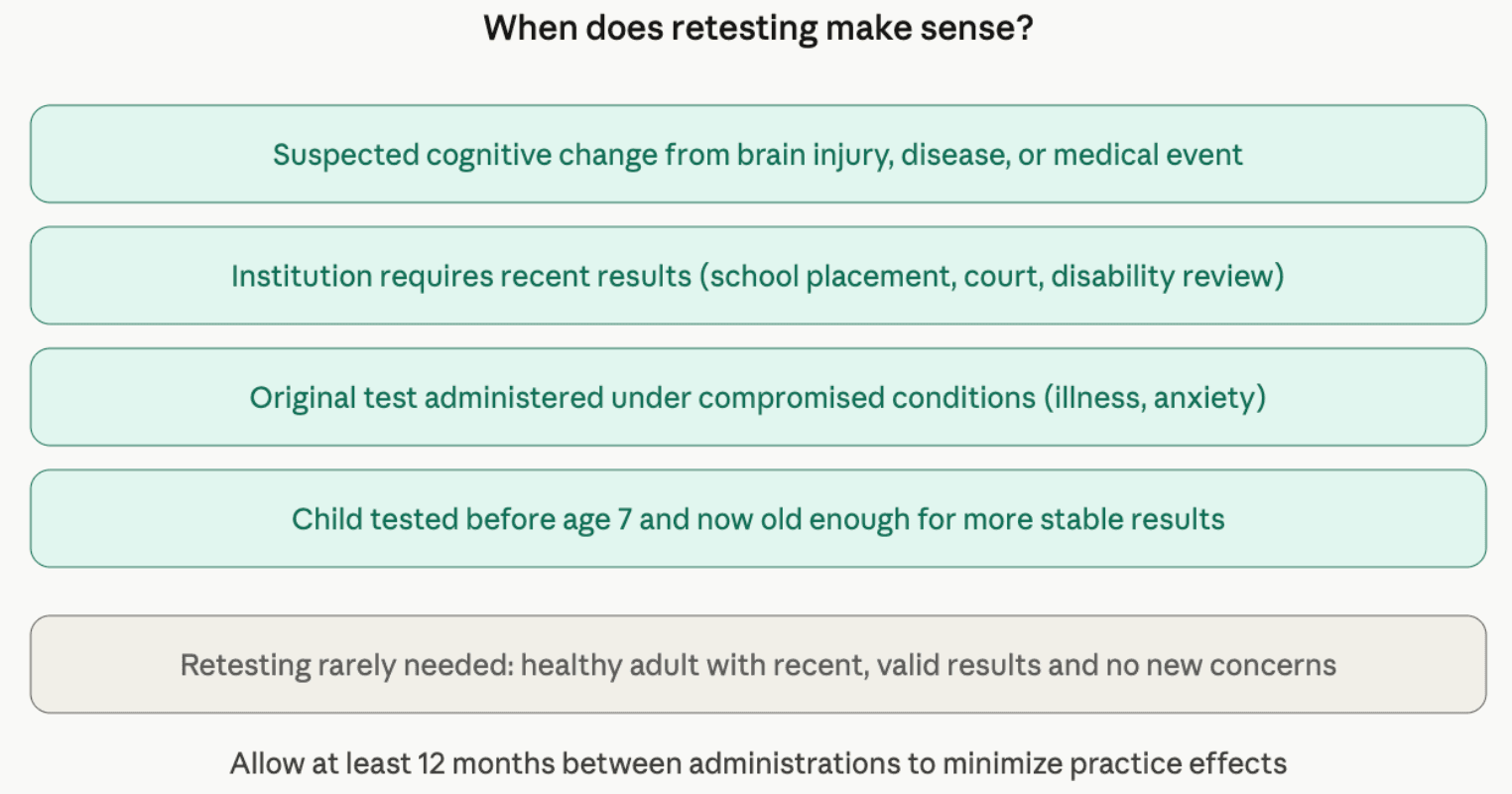
Putting It All Together
The right time to take an IQ test is determined by the intersection of need and readiness. The need is a question that cognitive data can answer — diagnostic, clinical, occupational, or personal. The readiness is a state in which the examinee can perform representatively: rested, healthy, free from acute distress, and not recently tested on the same instrument. For children, readiness also means sufficient developmental maturity for the scores to be stable enough to support decisions.
What does not change with timing is the importance of test quality. A well-timed test taken on a poorly constructed instrument still produces unreliable data. The Reasoning and Intelligence Online Test (RIOT) was built to address this problem. I created the RIOT after 15 years of intelligence research as the first online IQ test designed to meet professional standards for psychological assessment — including expert content review, a representative U.S.-based norm sample, and documented reliability and validity grounded in Cattell-Horn-Carroll theory. The RIOT reports six index scores — Verbal Reasoning, Fluid Reasoning, Spatial Ability, Working Memory, Processing Speed, and Reaction Time — and allows examinees to take subtests at their own pace, on their own schedule, during the hours when they are most alert. That flexibility puts the timing in the examinee's hands, where it belongs.
References
Breit, M., Scherrer, V., Tucker-Drob, E. M., & Preckel, F. (2024). The stability of cognitive abilities: A meta-analytic review of longitudinal studies. Psychological Bulletin, 150(4), 399–439. https://doi.org/10.1037/bul0000425 Deary, I. J. (2014). The stability of intelligence from childhood to old age. Current Directions in Psychological Science, 23(4), 239–245. https://doi.org/10.1177/0963721414536905 Gottfredson, L. S., & Deary, I. J. (2004). Intelligence predicts health and longevity, but why? Current Directions in Psychological Science, 13(1), 1–4. https://doi.org/10.1111/j.0963-7214.2004.01301001.x Kaufman, A. S., & Lichtenberger, E. O. (2006). Assessing adolescent and adult intelligence (3rd ed.). Wiley.
Roth, B., Becker, N., Romeyke, S., Schäfer, S., Domnick, F., & Spinath, F. M. (2015). Intelligence and school grades: A meta-analysis. Intelligence, 53, 118–137. https://doi.org/10.1016/j.intell.2015.09.001 Schaie, K. W. (2005). Developmental influences on adult intelligence: The Seattle Longitudinal Study. Oxford University Press.
Scharfen, J., Peters, J. M., & Holling, H. (2018). Retest effects in cognitive ability tests: A meta-analysis. Intelligence, 67, 44–66. https://doi.org/10.1016/j.intell.2018.01.003 Warne, R. T. (2020). In the know: Debunking 35 myths about human intelligence. Cambridge University Press. https://doi.org/10.1017/9781108593298 Warne, R. T. (2025). Technical manual for the Reasoning and Intelligence Online Test, version 1.0. Riot IQ.
Kaufman, A. S., Raiford, S. E., & Coalson, D. L. (2025). Cognitive aging revisited: A cross-sectional analysis of the WAIS-5. Journal of Intelligence, 13(6). https://doi.org/10.3390/jintelligence13060065 Deary, I. J., Whalley, L. J., Lemmon, H., Crawford, J. R., & Starr, J. M. (2000). The stability of individual differences in mental ability from childhood to old age: Follow-up of the 1932 Scottish Mental Survey. Intelligence, 28(1), 49–55. https://doi.org/10.1016/S0160-2896(99)00031-8 Tucker-Drob, E. M., & Briley, D. A. (2014). Continuity of genetic and environmental influences on cognition across the life span: A meta-analysis of longitudinal twin and adoption studies. Psychological Bulletin, 140(4), 949–979. https://doi.org/10.1037/a0035893
Take our professional IQ test
Want to know your IQ? Try the first ever professional online IQ test.
AuthorDr. Russell T. WarneChief Scientist
