Jun 15, 2026·Taking an IQ TestWhen Should You Consider Taking an IQ Test?
Wondering if a cognitive assessment is right for you? Discover the top reasons to measure your intelligence. Read the guide and take the RIOT IQ test!
Dr. Russell T. WarneChief Scientist
Most people who take an IQ test do so because someone else required it — a school psychologist, an employer, a clinician. That is understandable. Professionally administered IQ testing has traditionally been expensive, time-consuming, and difficult to access without a formal referral. But the question of when an IQ test is actually worth taking is worth examining on its own terms, separate from institutional requirements. IQ tests not for everyone in every situation. They are, however, genuinely useful in a wider range of circumstances than most people recognize. The question is not simply whether a test can be taken, but whether the information it provides is likely to change something meaningful — a decision, a plan, an understanding of oneself or one's child. When the answer to that is yes, testing is worth serious consideration.
This article covers the situations where an IQ test is most likely to provide that kind of value.
When a child is struggling in school despite apparent effort
The most common reason children are referred for IQ testing is that their academic performance does not match what teachers and parents expect of them. A child who appears attentive, engaged, and motivated but continues to fall behind presents a real diagnostic puzzle. Is the problem a learning disability? A processing issue? Something in the curriculum or instruction? Effort alone? IQ testing can help sort out those possibilities.
IQ testing can help identify learning differences when academic performance does not match effort or expectations. An intellectual functioning assessment can reveal patterns related to attention difficulties, learning disorders, or processing challenges.The key word there is "patterns." A full-scale IQ test does not just produce a single number — it produces a profile of scores across multiple cognitive domains, including verbal reasoning, working memory, processing speed, and spatial ability. Large discrepancies between those domains are often diagnostically meaningful. Consider what the profile can reveal when a child struggles to read. For students with learning disabilities, the full-scale IQ is often the least informative number in the assessment. What matters more is the pattern of scores across cognitive domains. Large discrepancies between indices are a hallmark of learning disabilities. A student whose fluid reasoning and verbal comprehension scores are well above average, but whose processing speed is significantly lower, is not a student who needs to try harder. That student has a profile that warrants a specific kind of instructional support — and without testing, teachers and parents are left guessing. Chronic underachievement often has cognitive roots that IQ testing can uncover. Testing can reveal average or above-average IQ with significantly lower achievement in specific areas, confirming a learning disability that requires specialized intervention rather than simply trying harder. Without that information, children may spend years being told to apply more effort to a problem that effort cannot fix.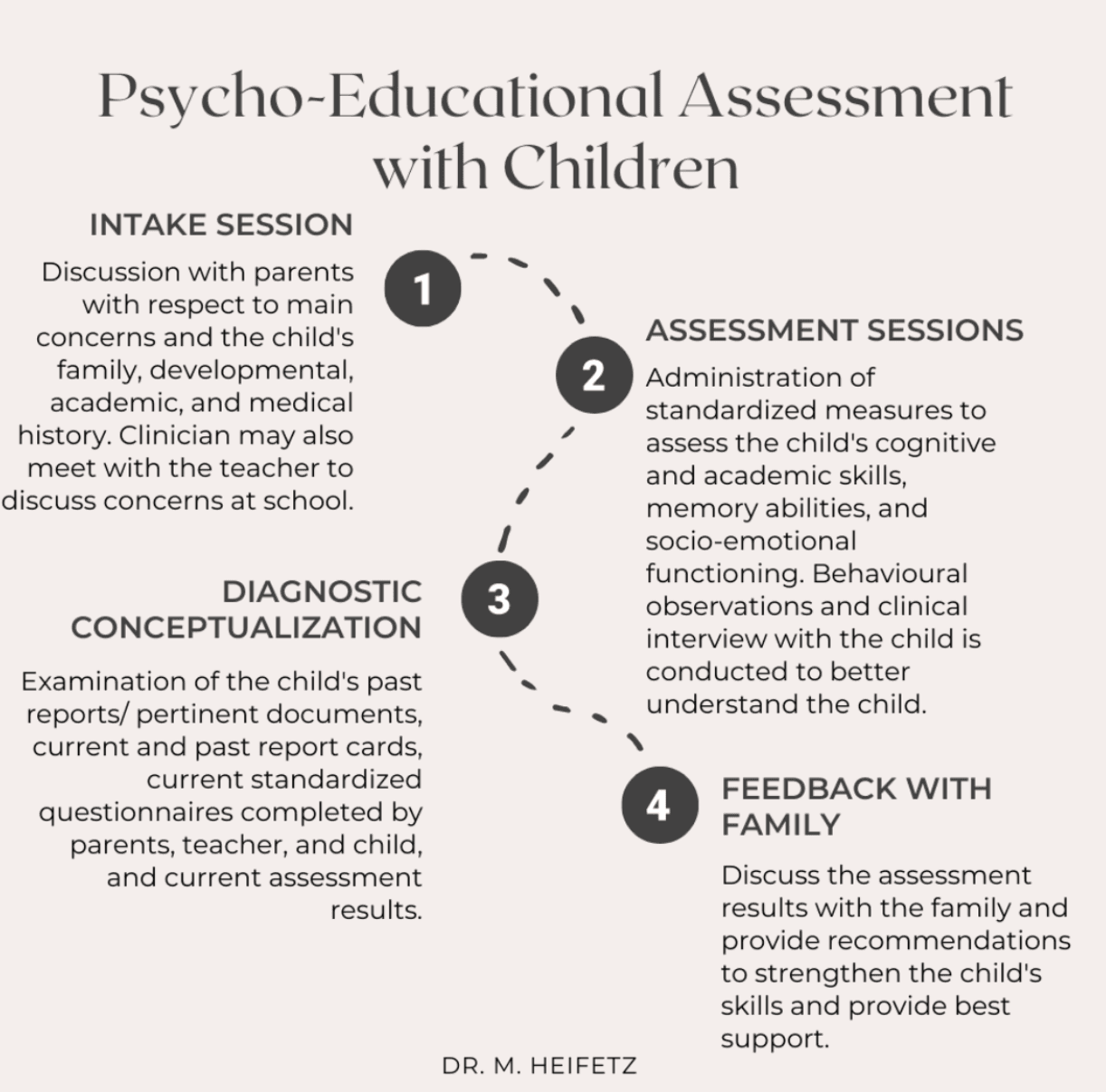
When a child appears gifted and needs appropriate placement
The same logic applies at the other end of the ability distribution. A child who is intellectually advanced for their age will often be bored, understimulated, and — counterintuitively — at risk of underperforming if they are not given work that matches their level. Without testing, exceptionally bright children may be bored, unchallenged, and develop behavioral problems or academic underachievement. Testing opens doors to appropriate educational opportunities and helps parents understand their child's unique needs.
Gifted identification is one of the most clearly evidence-supported uses of IQ testing in children. Measures of intelligence or cognitive abilities have traditionally and continue to be widely used in gifted identification. Intelligence or cognitive abilities measures are important predictors of school performance and future development. Most gifted programs require a formal IQ test as part of the identification process. Most programs require IQ testing showing scores at or above the 95th to 98th percentile. One important caveat for gifted assessment: the full-scale IQ is not always the right score to rely on. Gifted children may show higher mean scores on cognitive domains most heavily loaded for abstract reasoning — such as verbal comprehension, visual spatial ability, and fluid reasoning — and relatively lower mean scores on processing speed. Weaknesses in areas less relevant to advanced academic programming may lower the full-scale score below cutoffs for gifted identification. ERIC This is especially relevant for twice-exceptional children — those who are both intellectually gifted and have a co-occurring learning disability or attentional difficulty. For these children, a full-scale score alone can actively work against an accurate picture of their abilities.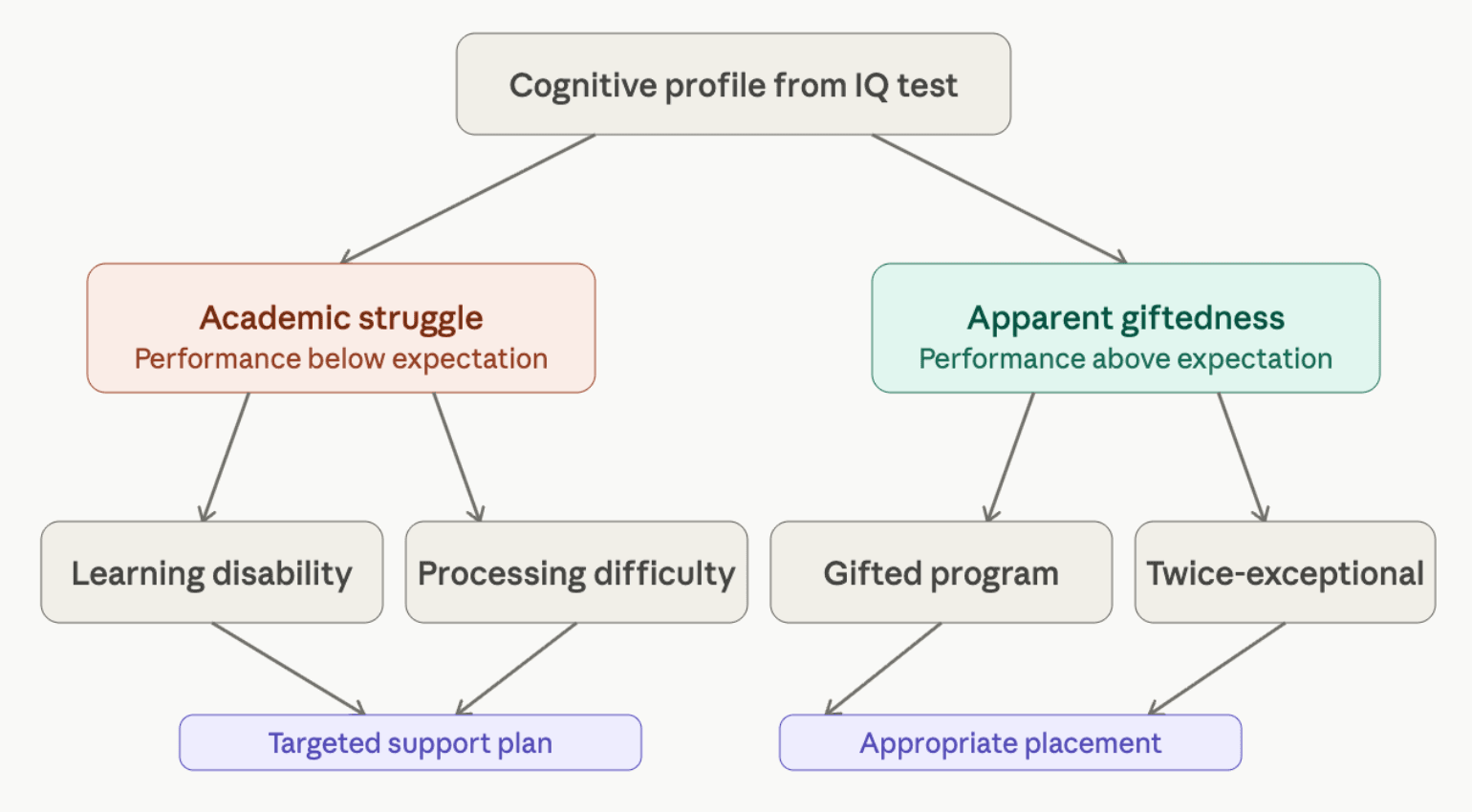
When a clinical or forensic evaluation requires it
Outside of school settings, IQ tests play a central role in clinical and forensic contexts. Mental health clinicians may administer an IQ test as part of a full psychological evaluation to understand a client's cognitive profile, which can be relevant to diagnosis, treatment planning, and prognosis. The relationship between cognitive ability and clinical outcomes is well established: research has shown that the effectiveness of certain therapies can vary based on a client's IQ level. That is clinically relevant information, and a test can provide it. In forensic settings — courtrooms, prisons, parole hearings, and competency evaluations — IQ scores can have significant legal consequences. They may be used to determine whether an individual is competent to stand trial, whether a criminal sentence should be modified due to intellectual disability, or whether a person qualifies for specific placements or protections under the law. These are high-stakes decisions, and they require high-quality tests, not the amateur instruments available for free online.
An intellectual functioning assessment can offer insight into how someone thinks and learns, helping guide educational planning, career decisions, or access to appropriate support. For adults in mental health settings, the value of an IQ test is not limited to diagnosis. It can clarify whether difficulties in a job or in managing daily responsibilities have a cognitive component that other assessments might miss.
When an adult wants to understand their own cognitive profile
One of the less-discussed but genuinely legitimate reasons to take an IQ test as an adult is simple self-knowledge. Understanding one's cognitive strengths and weaknesses is not a trivial exercise. It can inform decisions about education, career paths, and how to structure work and learning most effectively.
By understanding one's IQ profile, individuals can better understand their cognitive strengths and weaknesses. For instance, someone with high verbal comprehension might excel in careers that involve writing, teaching, or public speaking. Individuals with strong logical reasoning and analytical skills may be better suited for fields like engineering, data science, or finance.
This is not a new idea. Aptitude and cognitive testing for vocational guidance has been practiced for over a century, dating back to Frank Parsons' foundational work on vocational counseling in the early 1900s. The principle is straightforward: objective data about cognitive strengths reduces the guesswork in decisions about where to invest time and effort. People who work in roles that match their cognitive strengths tend to be more satisfied and more successful.
The difference between an IQ test and a general aptitude survey is that a professionally developed IQ test provides normed, standardized scores with documented psychometric properties. The result is not an impressionistic self-assessment but a comparison against a representative reference group, with known levels of measurement precision.
When performance at work or in demanding academic programs raises questions
A closely related motivation is when an adult is navigating a demanding career or academic environment and wants data-driven insight into whether their difficulties reflect a cognitive mismatch, a skills gap, or something else entirely.
Some individuals pursue IQ testing to better understand cognitive strengths that may influence career choices. Intellectual functioning assessments can highlight abilities related to reasoning, problem-solving, language, or analytical thinking that may align with certain professional paths. IQ testing is often used to evaluate if someone may meet the criteria for gifted programs or advanced academic placement.
In adult contexts, IQ testing also remains relevant in employment selection for cognitively demanding positions. The military's Armed Services Vocational Aptitude Battery is the largest-scale example in the United States, used to match recruits to appropriate roles. The predictive validity of cognitive ability tests for job performance — especially for complex roles — has been documented extensively. Meta-analyses of personnel selection research consistently show that cognitive ability is among the strongest predictors of job performance and training success, particularly for roles that require rapid learning and complex judgment. For individuals who are applying for graduate school, pursuing professional licensure, or entering a highly competitive field, understanding their cognitive profile can help them make realistic plans and allocate effort where it is most likely to pay off. This is not fatalism — it is informed decision-making.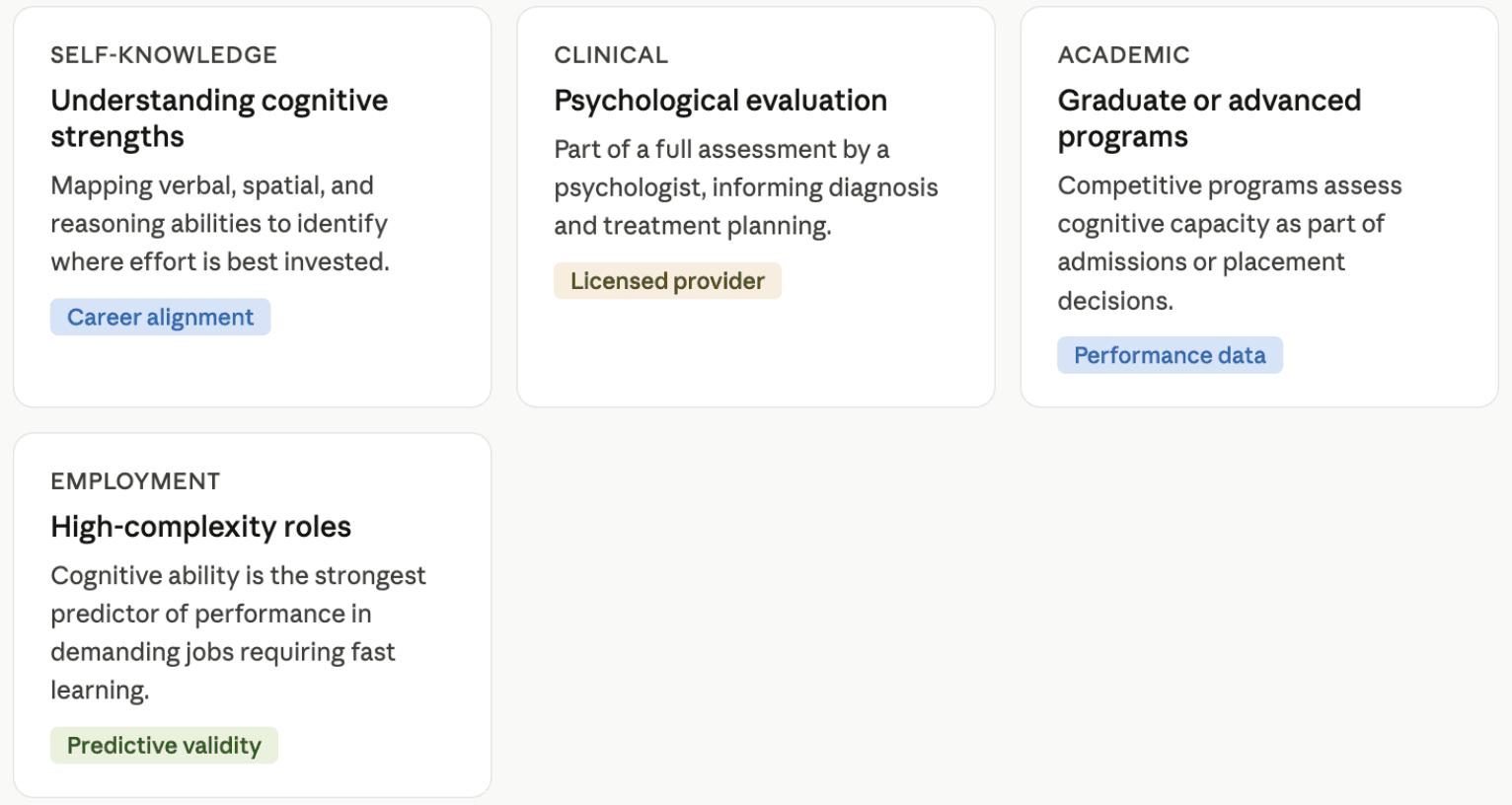
When cognitive changes in adulthood raise concern
A different and increasingly important context for IQ testing in adulthood is monitoring. As people age, cognitive abilities do change — processing speed and fluid reasoning tend to decline from middle age onward, while crystallized knowledge and verbal abilities remain relatively stable well into late life. Noticing a departure from one's own previous level of functioning is a legitimate reason to seek formal assessment.
The neuropsychological literature is clear that a cognitive baseline — a documented record of someone's performance earlier in life — is extremely valuable for detecting subsequent decline. Cognitive assessments can provide a baseline to track progression of disease or to document the effects of medications or behavioral interventions. Performance on neuropsychological tests can reveal areas of daily functioning where the patient may need assistance, guiding intervention strategies to ameliorate cognitive deficits.
One finding that is not widely appreciated outside the clinical community is that standard cognitive screening tools often fail to detect early decline in high-functioning adults. Traditional approaches to neuropsychological assessment may fail to detect cognitive decline in high-functioning older adults. In one sample of 42 highly intelligent older individuals, no participants had any cognitive impairments using age-based norms; but when using IQ-adjusted norms, 47.6% were detected as having either executive or memory impairments, which predicted further decline at 3.5 years follow-up. PubMed Central A person who was cognitively exceptional at age 40 and declines to merely average at 65 may look unremarkable on a routine screening test — because "average" is normal by population standards. A baseline IQ score allows for a much more sensitive comparison against that person's own prior level. The neuropsychological examination can document normal mental state in an individual with cognitive symptoms and then serve as a baseline against which future changes can be measured. For adults who are approaching middle age or entering professions with long cognitive demands — medicine, law, academia, executive leadership — establishing a baseline now is a form of due diligence.
When curiosity about one's own mind is reason enough
There is also a simpler and perfectly valid reason to take an IQ test: genuine curiosity. IQ is among the most studied individual differences in all of psychology. The research linking IQ to health, longevity, educational attainment, income, and a wide range of life outcomes is extensive and robust. For a person who wants to understand where they stand — not to satisfy an employer or a clinician, but simply to know — a professional test is the right tool.
An intellectual functioning assessment can offer insight into how someone thinks and learns, helping guide educational planning and career decisions, or provide personal insight.The report that comes with a professionally scored IQ test is far more informative than a single number. It typically includes scores for verbal reasoning, fluid reasoning, working memory, processing speed, and other abilities, along with percentile ranks and confidence intervals that place those scores in context.
What testing for curiosity's sake requires, though, is an honest assessment from a test worth taking. A free online quiz that returns a flattering score in three minutes is not providing information — it is providing a number that feels good. A professionally developed test built on a representative norm sample, with documented reliability and validity, provides information that has some claim to accuracy.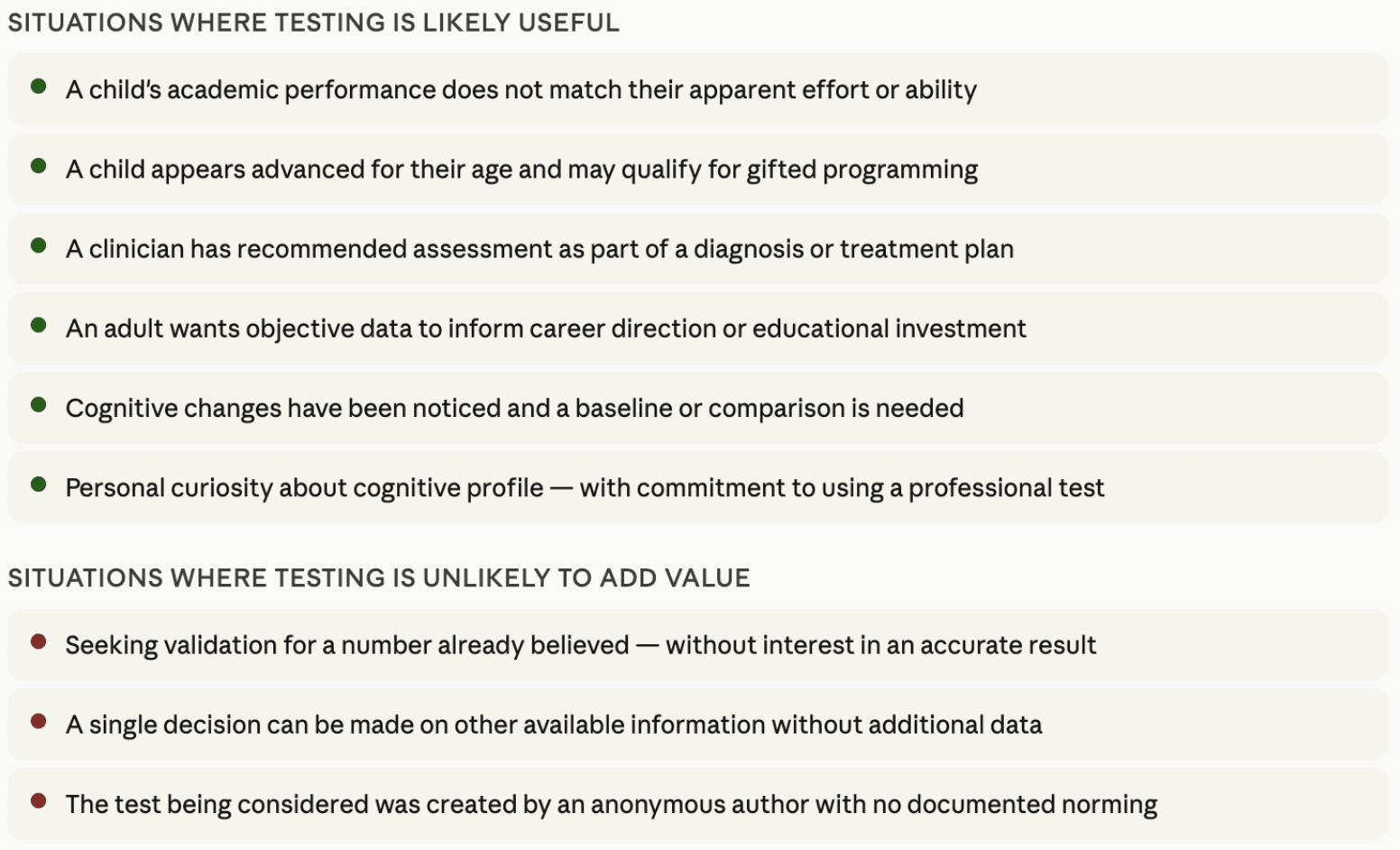
What to look for in a test worth taking
Identifying a situation where IQ testing might be useful is only the first step. The second is finding a test that will actually provide accurate information. The research on reliability and validity that makes professional IQ scores meaningful only applies to professionally developed tests — not to the thousands of amateur quizzes that use the phrase "IQ test" as a marketing hook.
Common assessments include the Wechsler Adult Intelligence Scale (WAIS-IV) for adults and the Wechsler Intelligence Scale for Children (WISC-V) for school-age test-takers. These tests help identify patterns in cognitive strengths and challenges that may influence learning, problem-solving, and everyday functioning.These are the gold-standard individually administered tests, available only through licensed psychologists and qualified clinicians.
For adults who are not in a clinical context, the Reasoning and Intelligence Online Test (RIOT) is a professionally developed alternative. It was built by me, Dr. Russell Warne, following 15 years of intelligence research, and it was normed on a representative U.S. sample — not self-selected internet users. It meets the standards for educational and psychological testing established by the American Psychological Association, the American Educational Research Association, and the National Council on Measurement in Education. The RIOT underwent the same rigorous development process as traditional in-person IQ tests: expert review, proper norm sampling, and documented reliability and validity.
When not to take an IQ test
A complete answer to the question of when to consider testing must also include situations where the results would not change anything that matters. If the purpose is simply to obtain a high number rather than accurate information, the test is not being used as a measurement instrument.
One situation that deserves specific mention is the re-testing scenario. People sometimes want to take an IQ test repeatedly to achieve a higher score. As I explain in my own published research, practice effects on IQ tests are real — retaking the same test produces a score increase of approximately 5 IQ points on the second administration and about 3 points on the third. But that increase does not reflect an actual increase in intelligence. It reflects familiarity with the test's format. A score inflated by practice effects is not a more accurate score; it is a less accurate one.
The legitimate reasons to take an IQ test are all grounded in the same basic logic: the score will provide information that is currently unknown and that is relevant to a decision or understanding that matters. When that logic holds, testing is worth it. When it does not, the most useful test is no test at all.
Sources
Verdant Psychology. (2025). Should I get IQ tested? Verdant Psychology Blog. Koffman, M. (2025). Does my child need an IQ test? Dr. Michael Koffman. Harrison, P. L., & Wiley, A. L. (2008). Assessment of giftedness in school-age children using measures of intelligence or cognitive abilities. In S. Pfeiffer (Ed.), Handbook of giftedness in children. Springer. Maki, P. M., et al. (2022). Neuropsychological assessment in dementia diagnosis. Continuum: Lifelong Learning in Neurology, 28(3). Flanagan, D. P., & Kaufman, A. S. (2009). Essentials of WISC-IV assessment. Wiley.
Schmidt, F. L., & Hunter, J. E. (1998). The validity and utility of selection methods in personnel psychology. Psychological Bulletin, 124(2), 262–274. Warne, R. T. (2025). Technical manual for the Reasoning and Intelligence Online Test, version 1.0. RIOT IQ.
American Educational Research Association, American Psychological Association, & National Council on Measurement in Education. (2014). Standards for educational and psychological testing. https://www.testingstandards.net/
Take our professional IQ test
Want to know your IQ? Try the first ever professional online IQ test.
AuthorDr. Russell T. WarneChief Scientist
