Jun 8, 2026·Taking an IQ TestHow to Choose the Right IQ Test for Your Needs
Need an accurate cognitive assessment? Learn how to spot fake quizzes and choose the right IQ test for your goals. Read the guide and try the RIOT test!
Dr. Russell T. WarneChief Scientist
People seek IQ tests for many different reasons. Some are students who want to understand their cognitive profile before pursuing graduate school. Others are employers evaluating candidates, clinicians building a fuller picture of a patient, or simply curious adults who have wondered about their own cognitive abilities. Each of those situations has a different need; no IQ test will work for all of these examinees. The market for IQ tests is. A clinical psychologist has many tests, and it can be challenging to pick the right one for a particular client. A Google search for “IQ test” produces thousands of results, including websites claiming to give examinees instant results. Navigating between these two extremes requires understanding what makes a test trustworthy, what purpose it serves, and what its scores actually mean. This article is a guide to making that decision carefully.
What is the right starting point: purpose or quality?
Before considering any specific test, it helps to ask a straightforward question: why does the score matter?
The answer shapes nearly every subsequent decision. A clinician who needs to assess whether a patient may have an intellectual disability requires a very different instrument than an adult who simply wants to satisfy personal curiosity. An employer designing a selection process for cognitively demanding jobs needs a different test than a researcher studying the relationship between cognitive ability and health outcomes.
Purpose and quality are both necessary. A high-quality test used for the wrong purpose produces misleading decisions. A low-quality test used for any purpose produces unreliable data.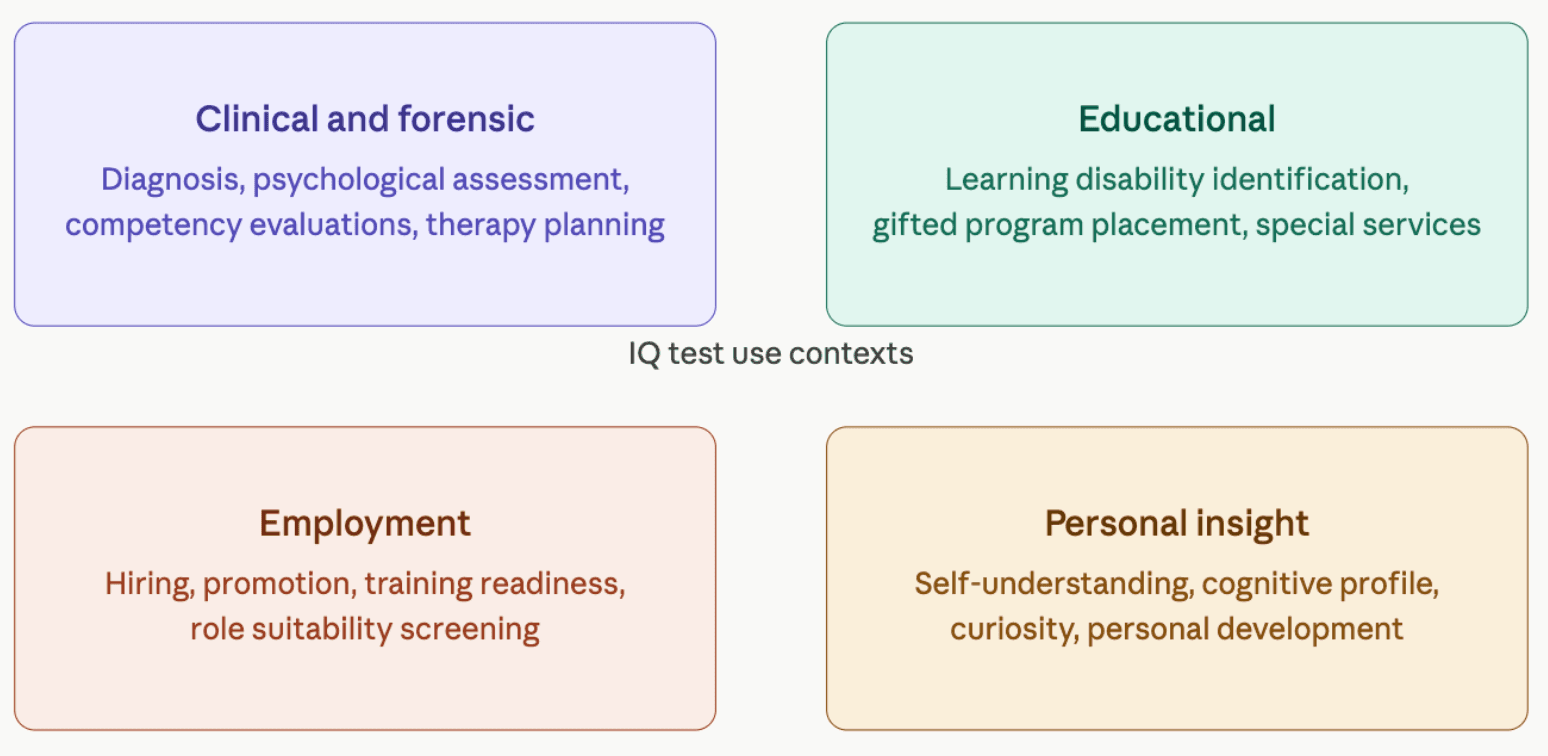
Who should be administering the test?
The administration context matters as much as the test itself. Individually administered tests are the gold standard for clinical and educational decisions. Tests like the Wechsler Adult Intelligence Scale (WAIS-V), the Woodcock-Johnson Tests of Cognitive Abilities V, and the Stanford-Binet Intelligence Scales require a trained professional to administer and interpret. The administrator follows a standardized script, observes how the examinee approaches each task, and accounts for behavioral factors — anxiety, fatigue, disengagement — that could affect the result. The resulting report is thorough, legally defensible, and appropriate for high-stakes decisions. These assessments take 90 minutes or longer to administer. In private practice settings in the United States, they typically cost hundreds or even thousands of dollars.
Group-administered tests occupy a different space. They are designed to be efficient, allowing dozens or hundreds of people to be tested simultaneously and are the most common tests used in school settings and military contexts. These assessments are appropriate when standardized comparisons across large populations are more important than individual-level clinical precision.
Online tests are the newest category and the most variable in quality. The fact that a test is administered online does not, by itself, say anything about its scientific merit. What matters is whether the test was developed by qualified professionals using the same psychometric rigor applied to traditional tests. Unfortunately, most online IQ tests are created by non-professionals who are unaware of, or indifferent to, the technical and ethical standards that define good psychological measurement.
What makes a test professionally developed?
The single most important distinction in the IQ test market is between professionally developed tests and amateur-built ones. This distinction is not about aesthetics or price. It is about whether the test produces data that is accurate enough to be trusted.
Professional test development is a multi-year process governed by a body of standards called the Standards for Educational and Psychological Testing, published jointly by the American Educational Research Association, the American Psychological Association, and the National Council on Measurement in Education. These standards define expectations for test validity, reliability, norm sampling, and ethical use. There are several things to look for when evaluating whether a test meets professional standards.
Identifiable authorship. Professional test creators attach their names to their work. They are credentialed experts with graduate training in psychometrics who are willing to be held accountable for the quality of what they have built. Anonymous tests or tests created by hobbyists should always be avoided.
Technical documentation. High-quality tests produce a test manual, which is a book-length document describing the test’s development process, validation data, reliability statistics, score interpretation, and more. The existence of technical documentation signals that the test was developed systematically rather than improvised.
A representative norm sample. An IQ score is a relative measure. It compares an examinee's performance to a reference group (called a norm sample). If that reference group is not representative of the population the test is intended for, the comparison is distorted. Professional tests document exactly who is in their norm sample, how those people were recruited, and what demographic characteristics they have.
Independent expert review. Before a test reaches the public, professional test developers submit it to independent review by subject matter experts. After publication, additional review comes in the form of published research studies. Searching for a test's name in Google Scholar is a quick way to find out whether other researchers have used or evaluated it. Alignment with a scientific theory. Tests that measure a construct as broad as intelligence need a theoretical framework to guide decisions about what to measure and how. The most well-supported framework in contemporary intelligence research is the Cattell-Horn-Carroll (CHC) theory, a hierarchical model that organizes cognitive abilities from narrow, specific skills at the base to broad cognitive domains in the middle and a general factor (g) at the top.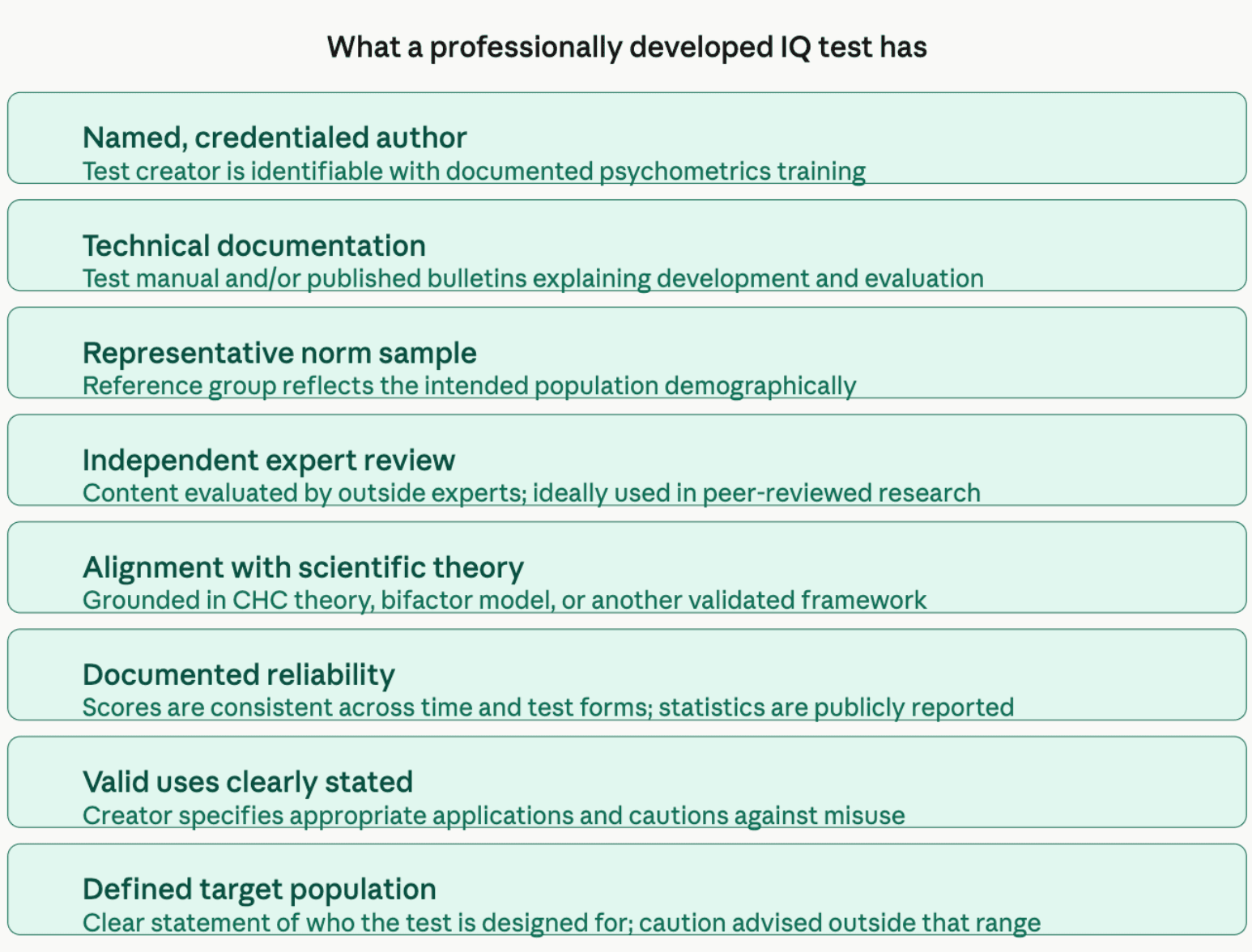
Understanding reliability and validity
Two technical concepts are fundamental to evaluating any IQ test: reliability and validity. These terms are frequently used casually in conversation, but they have precise meanings in psychometrics.
Reliability refers to the consistency of test scores. A test that produces reliable produces similar scores when the same person takes it under similar conditions on different occasions. Most professionally developed IQ tests achieve test-retest reliability between .80 and .95 on a scale from 0 to 1. The Wechsler Adult Intelligence Scale IV has a test-retest reliability of approximately .94 for full-scale IQ. Reliability is influenced by several factors. Longer tests generally provide more reliable results than shorter ones, which explains why comprehensive IQ batteries like the Wechsler scales or the Stanford-Binet Intelligence Scales require about 90 minutes to complete. Brief screeners sacrifice some reliability for convenience. Administration conditions also matter: professional tests have strict guidelines ensuring every test taker has an identical experience, and consistent procedures increase reliability while varying conditions diminish it. Validity is a different property. While reliability asks whether test scores are consistent, validity asks whether the scores support the inferences being made from them. Validity is not a property of the test itself but of the inferences drawn from scores. A test can produce reliable scores (i.e., consistent scores) while still being invalid for a particular purpose. Professional test creators are specific about what their tests are and are not valid for, and claims that a test is simply "valid" without qualification are scientifically imprecise.
What types of scores should a good test report?
IQ tests that produce only a single composite score tell an incomplete story. While the overall IQ score is genuinely meaningful and predictive, a good test also provides sub-scores that reveal the specific pattern of a person's cognitive strengths and weaknesses.
The CHC theory organizes cognitive ability into broad domains that include fluid reasoning, crystallized knowledge, visual-spatial processing, short-term memory, processing speed, and more. A test that reports scores in these domains gives richer information than a single number alone.
The Reasoning and Intelligence Online Test (RIOT), for example, reports an overall IQ score alongside index scores for Verbal Reasoning, Fluid Reasoning, Spatial Ability, Working Memory, Processing Speed, and Reaction Time. This profile matters because a pattern of scores can reveal strengths and weaknesses. An IQ score alone can’t do that. Single-format tests use only one task type. A classic example is the Raven's Progressive Matrices. Single-format tests are simpler instruments measuring a narrower slice of cognitive ability. This is not necessarily a flaw; single-format tests can be excellent for specific purposes, such as group screening or research contexts where a single reliable indicator of g is sufficient. But they cannot provide the breadth of information that a full test battery offers.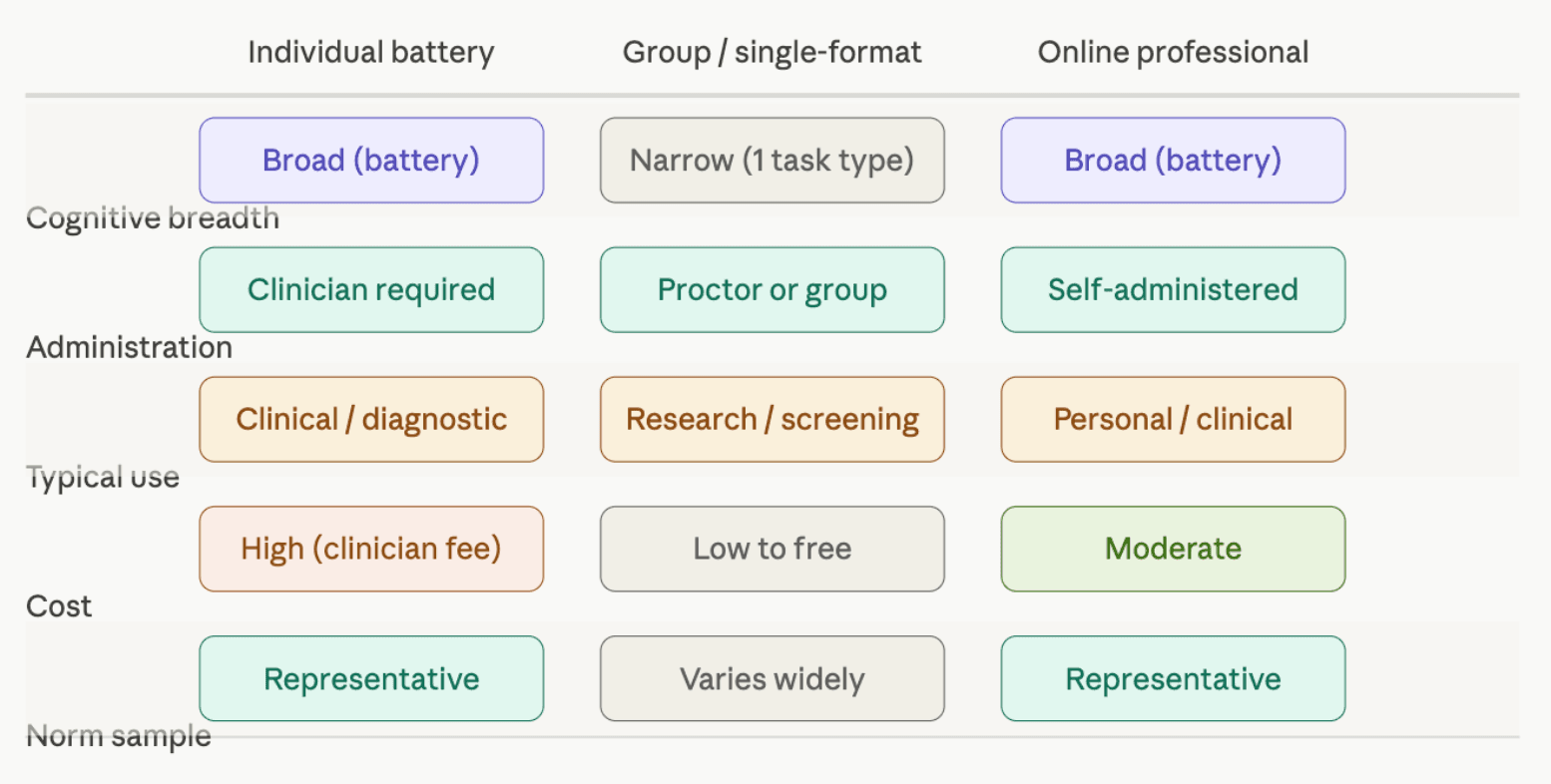
Why the norm sample is more important than most people realize
When an IQ test produces a score of 115, that number is only meaningful in relation to a reference group (called a norm sample). The score means the examinee performed better than approximately 84% of the norm sample. If the norm sample is not representative of the population, that comparison is distorted.
In the development of norm-referenced psychometric tests, demographically representative samples provide the foundation for valid norm scores. The demographic variables most commonly accounted for include age, gender, race or ethnicity, education level, and socioeconomic status. Most online tests do not meet this requirement. The people who voluntarily seek out internet IQ tests tend to be male, younger, more educated, and more interested in intellectual performance than average. They are a self-selected group that is not representative of the broader population. A norm sample built from this group will distort comparisons and produce incorrect scores.
Matching the test to the decision
For high-stakes clinical or educational decisions (e.g., a diagnosis of intellectual disability, placement in a special education program, a psychological evaluation for legal proceedings), the standard is an individually administered battery given by a trained professional. The WAIS-V for adults and the WISC-V for children are the most widely used instruments in the United States for these purposes. No online test, however well developed, is currently accepted as a replacement for a clinician-administered battery in high-stakes legal or diagnostic contexts. For employment screening at the organizational level, the goal is usually efficiency. Test administrators usually want to test many candidates and identify those with the cognitive capacity to learn the job quickly and perform well. Group-administered cognitive ability tests, or professionally developed online instruments used at scale, are appropriate here. The key requirement is documented predictive validity for job performance and a norm sample that supports accurate comparisons.
For research and data collection, the most important property is standardization and that the test is appropriate for the research participants. There needs to be consistency of administration and scoring that allows data to be aggregated and compared across participants.
For personal curiosity or self-assessment, the range of appropriate tests is wider. A person who wants to understand their cognitive profile and is not making a high-stakes decision can benefit meaningfully from a professionally developed online test. The key distinction, as throughout this article, is "professionally developed."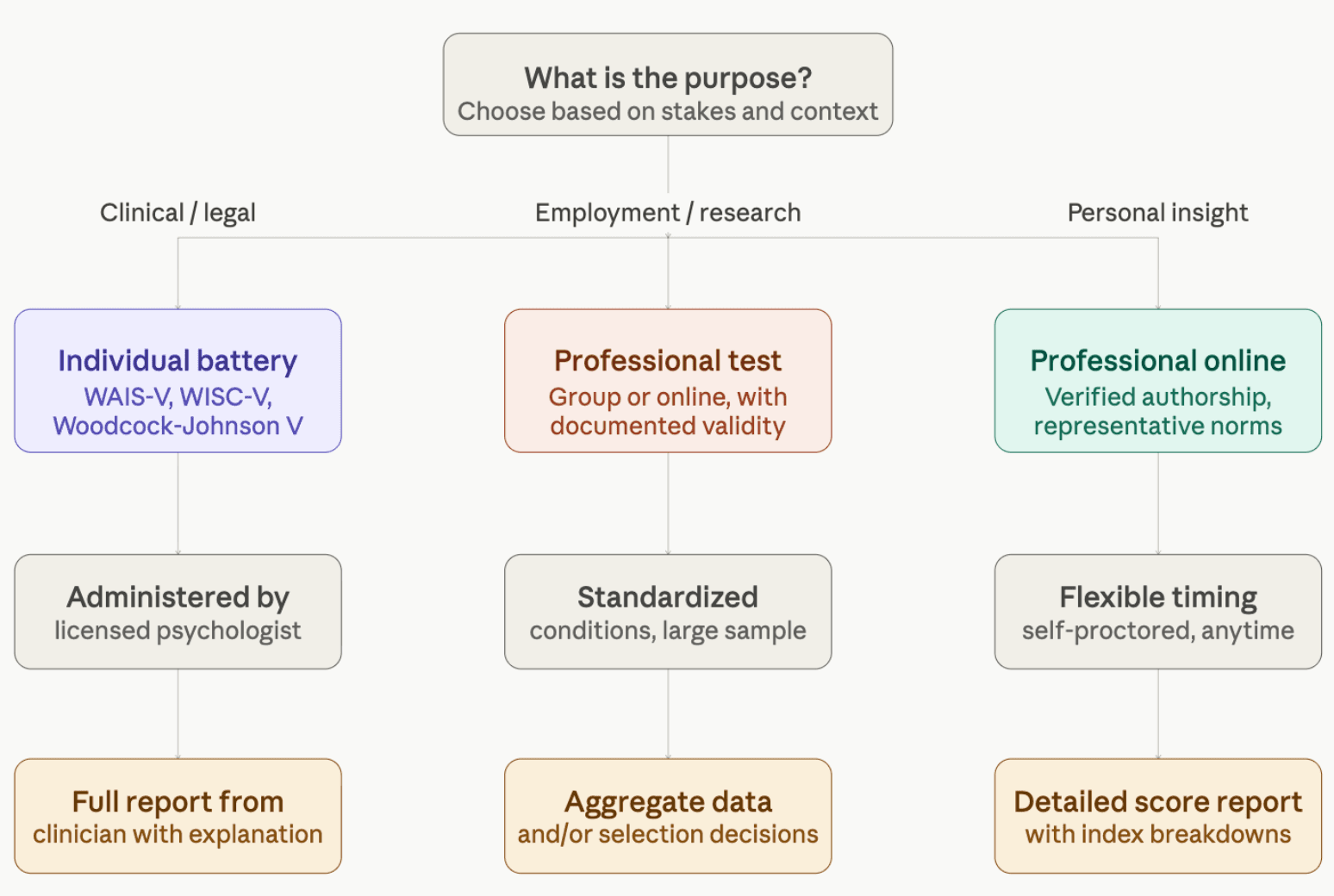
The problem with most online tests
The online IQ testing market has a significant problem: the vast majority of tests available through a Google search do not meet professional standards. They are typically built by developers with no background in psychometrics, administered without standardization, and normed — if at all — on self-selected groups of internet users whose profile, as described above, systematically distorts comparisons.
These tests share several predictable features. They are short, often comprising fewer than 20 questions, which severely limits reliability. They rarely disclose who created them or what credentials that person holds. And they consistently report scores that skew high — not as accurate measurement, but as a commercial mechanism to encourage purchase of a detailed "certificate."
None of this means that online testing is inherently problematic. The question is not whether a test is delivered online, but whether the people who built it had the expertise to do so rigorously. Demographically representative samples provide the foundation for valid norm scores, and building that foundation requires professional expertise, substantial resources, and time that cannot be assembled by a web developer working alone.
Red flags to watch for
An anonymous creator is the most reliable warning sign. Any developer who will not attach their name to a test has no professional reputation to protect and no accountability for errors. Professional test creators are proud of their work and understand that credibility depends on transparency.
No technical documentation is the second major flag. If a test website provides no information about how the test was developed, who reviewed it, how the norm sample was assembled, or what reliability statistics it achieved, those things either do not exist or are deliberately hidden.
Implausibly rapid scoring is a third warning. An IQ test consisting of 10 or 15 questions is only useful for basic research purposes. They are not informative about individual examinees and do not provide.
Claims that the test is appropriate for everyone should also raise concern. No test is appropriate for everyone to take. Professional test creators are explicit about who their tests are designed for, and the absence of any statement about intended population suggests the creator has not thought carefully about where the test works and where it does not.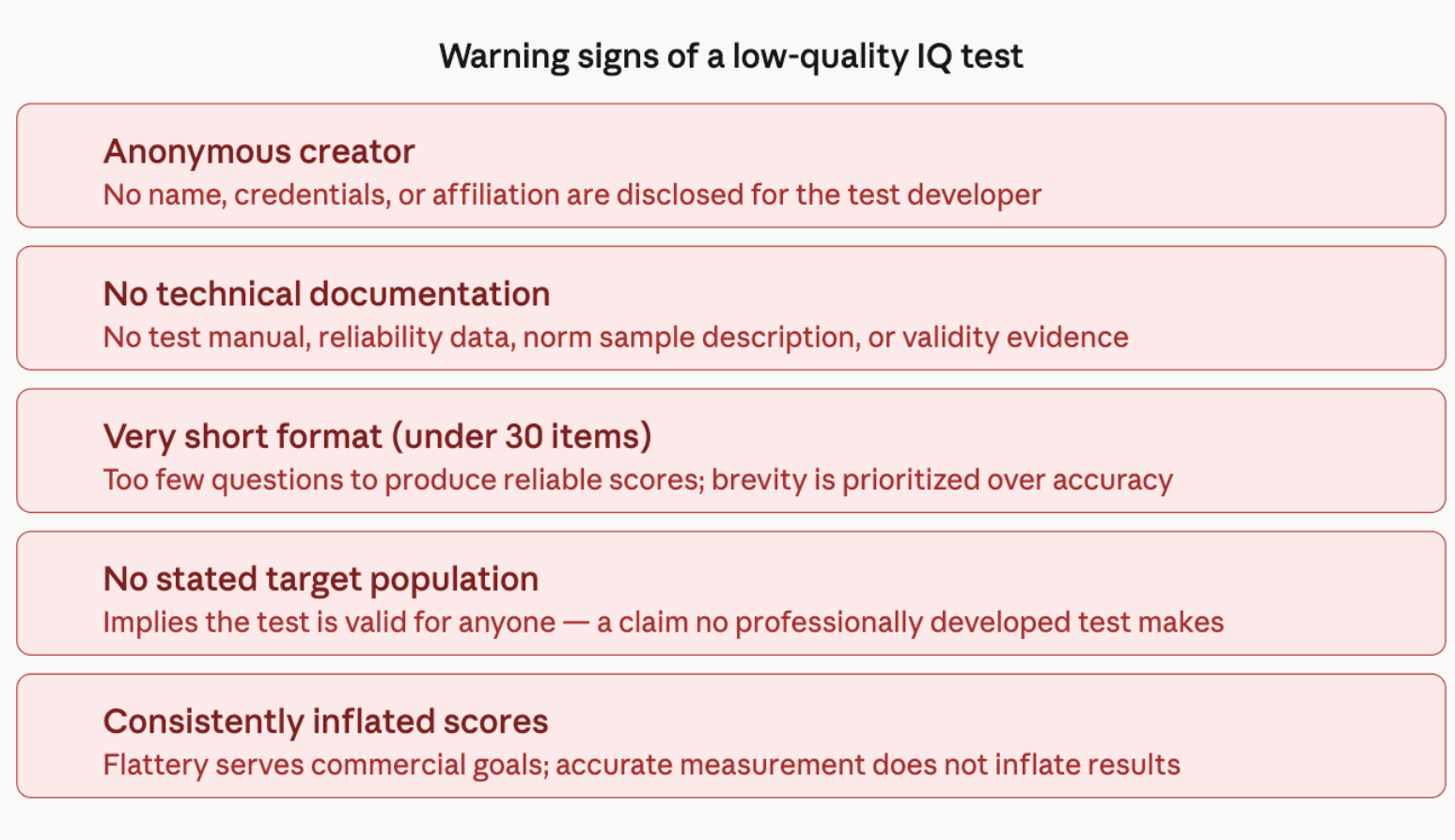
Some specific tests worth knowing
The Wechsler Adult Intelligence Scale (WAIS-V) is the most widely used individual intelligence test for adults in the United States. It produces a full scale IQ and index scores for five broad cognitive domains: It was updated in 2024 and has an extensive research base accumulated over decades.
The Woodcock-Johnson Tests of Cognitive Abilities V is another individually administered battery widely used in educational settings, particularly valued for its alignment with CHC theory and its utility in identifying specific learning disabilities alongside academic achievement tests.
The Stanford-Binet Intelligence Scales, Fifth Edition can measure intelligence in both children and adults across a wide age range. It remains a respected instrument with a strong research base, though it is somewhat less commonly used than the Wechsler scales in the United States.
The Raven's Progressive Matrices family are widely used single-format tests. Their nonverbal matrix-reasoning format makes them less sensitive to verbal ability and cultural knowledge, making them excellent measures of g and fluid reasoning, though without the breadth of a full battery. The latest version is allied the Raven’s 2.
The Reasoning and Intelligence Online Test (RIOT) is the first professionally developed online IQ test. It was created by Dr. Russell T. Warne, who has more than 15 years of intelligence research experience, including peer-reviewed publications and a Cambridge University Press book on the topic. The RIOT is based on the CHC model, was reviewed by a panel of experts from cognitive, educational, and developmental psychology, and was normed on a representative U.S. sample. It meets the Standards for Educational and Psychological Testing established by the APA, AERA, and NCME, and reports a full IQ alongside index scores for Verbal Reasoning, Fluid Reasoning, Spatial Ability, Working Memory, Processing Speed, and Reaction Time. For adults who want a professional assessment they can complete at a time and place of their choosing, the RIOT is a rigorous and accessible option.
What to do with the score after the test
The score itself is only the beginning. A number without context is not particularly useful. A good test provides a detailed score report that explains what the overall IQ and any sub-scores mean, where the examinee's performance falls in the population distribution, and what the appropriate limits of interpretation are. For individually administered tests, the clinician typically provides a written report and an opportunity to ask questions.
IQ scores are best understood probabilistically. A score of 115 does not guarantee successful performance in a given career or educational path; it indicates that the person’s cognitive abilities are above the population average. That test performance is associated with somewhat better than average outcomes across a range of domains. The relationship between IQ and life outcomes is real and meaningful, but it is not deterministic. Other factors, like effort, personality, circumstances, specific skills, also matter.
A test battery covering the major domains of the CHC framework captures a great deal, but it does not measure motivation, creativity, domain-specific expertise, or the many narrow abilities that are relevant in particular fields. The score is a starting point for understanding cognitive ability, not a complete portrait of a person.
Sources
Warne, R. T. (2020). In the know: Debunking 35 myths about human intelligence. Cambridge University Press. https://doi.org/10.1017/9781108593298 American Educational Research Association, American Psychological Association, & National Council on Measurement in Education. (2014). Standards for educational and psychological testing. https://www.testingstandards.net/ Warne, R. T., Astle, M. C., & Hill, J. C. (2018). What do undergraduates learn about human intelligence? An analysis of introductory psychology textbooks. Archives of Scientific Psychology, 6(1), 32–50.
Gottfredson, L. S. (1997). Mainstream science on intelligence: An editorial with 52 signatories, history, and bibliography. Intelligence, 24(1), 13–23. https://doi.org/10.1016/S0160-2896(97)90011-8 Carroll, J. B. (1993). Human cognitive abilities: A survey of factor-analytic studies. Cambridge University Press.
Deary, I. J., Strand, S., Smith, P., & Fernandes, C. (2007). Intelligence and educational achievement. Intelligence, 35(1), 13–21. https://doi.org/10.1016/j.intell.2006.02.001 Schmidt, F. L., & Hunter, J. E. (2004). General mental ability in the world of work: Occupational attainment and job performance. Journal of Personality and Social Psychology, 86(1), 162–173. https://doi.org/10.1037/0022-3514.86.1.162 Lenhard, A., Lenhard, W., Suggate, S., & Segerer, R. (2016). A continuous solution to the norming problem. Assessment, 26(6), 1103–1115. https://doi.org/10.1177/1073191116656437 Warne, R. T. (2025). Technical manual for the Reasoning and Intelligence Online Test, version 1.0. RIOT IQ.
Warne, R. T., & Burningham, C. (2019). Spearman's g found in 31 non-Western nations: Strong evidence that g is a universal phenomenon. Psychological Bulletin, 145(3), 237–272. https://doi.org/10.1037/bul0000183 Deary, I. J. (2012). Intelligence. Annual Review of Psychology, 63(1), 453–482. https://doi.org/10.1146/annurev-psych-120710-100353 Nisbett, R. E., Aronson, J., Blair, C., Dickens, W., Flynn, J., Halpern, D. F., & Turkheimer, E. (2012). Intelligence: New findings and theoretical developments. American Psychologist, 67(2), 130–159. https://doi.org/10.1037/a0026699 Plomin, R., & Deary, I. J. (2015). Genetics and intelligence differences: Five special findings. Molecular Psychiatry, 20(1), 98–108. https://doi.org/10.1038/mp.2014.105 Ritchie, S. J., Bates, T. C., & Deary, I. J. (2015). Is education associated with improvements in general cognitive ability, or in specific skills? Developmental Psychology, 51(5), 573–582. https://doi.org/10.1037/a0038981 Wechsler, D. (2024). Wechsler Adult Intelligence Scale — Fifth Edition (WAIS-V). NCS Pearson.
McGrew, K. S. (2009). CHC theory and the human cognitive abilities project: Standing on the shoulders of the giants of psychometric intelligence research. Intelligence, 37(1), 1–10. https://doi.org/10.1016/j.intell.2008.08.004 te Nijenhuis, J., & van der Flier, H. (2013). Is the Flynn effect on g? A meta-analysis. Intelligence, 41(6), 802–807. https://doi.org/10.1016/j.intell.2013.03.001 Sackett, P. R., Borneman, M. J., & Connelly, B. S. (2008). High-stakes testing in higher education and employment: Appraising the evidence for validity and fairness. American Psychologist, 63(4), 215–227. https://doi.org/10.1037/0003-066X.63.4.215 Raven, J. (2000). The Raven's Progressive Matrices: Change and stability over culture and time. Cognitive Psychology, 41(1), 1–48. https://doi.org/10.1006/cogp.1999.0735 Warne, R. T. (2016). Testing Spearman's p ("the indifference of the indicator") in five ability domains and forty-five nations. Intelligence, 55, 81–88. https://doi.org/10.1016/j.intell.2016.01.006
Take our professional IQ test
Want to know your IQ? Try the first ever professional online IQ test.
AuthorDr. Russell T. WarneChief Scientist
