What is the average IQ by profession? Real occupational data from Wonderlic norms and major studies, plus why every job spans a wide range of scores.
Dr. Russell T. WarneChief Scientist
Share
Occupational averages run from the low 90s for the least cognitively demanding jobs to the mid-to-high 110s for physicians, professors, engineers, and lawyers. Nearly every credible "IQ by job" table traces back to two sources: Wonderlic applicant norms analyzed by Gottfredson (1997) and longitudinal research such as the Wisconsin Longitudinal Study, where occupational medians ranged from 92.4 to 118.7. The other half of the story is just as important: every profession contains a wide range of scores, and the overlap between fields is enormous.
The verified numbers: IQ benchmarks by job
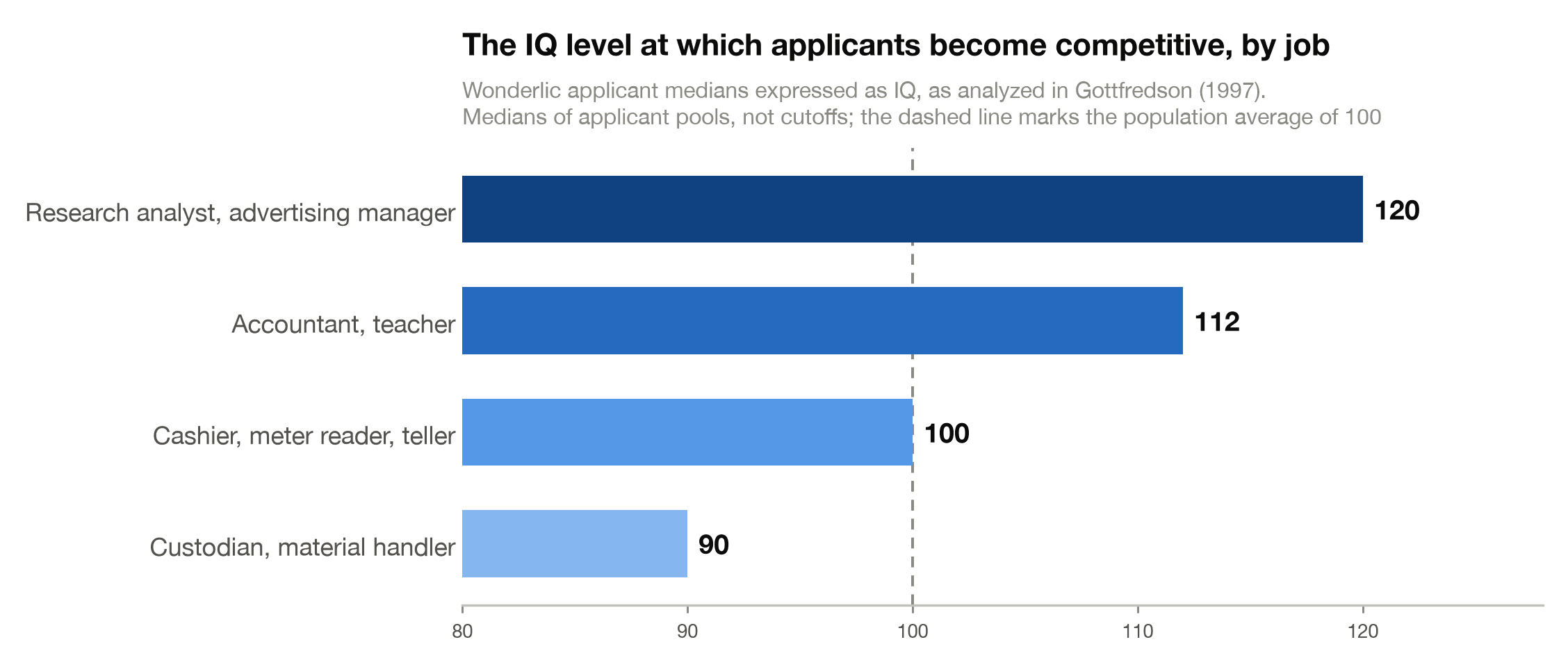
Gottfredson's analysis of Wonderlic Personnel Test applicant data, which she calls the most comprehensive publicly available data on the cognitive demands of civilian jobs, translates applicant medians into IQ terms:
• About IQ 120: competitive for the highest-level jobs in the dataset, such as research analyst and advertising manager (the 91st percentile of the general population).
• About IQ 112: competitive for accountant and teacher (the 81st percentile).
• About IQ 100: typical for cashier, meter reader, and teller (the 50th percentile).
• About IQ 90: typical for custodian and material handler (the 25th percentile).
The Wisconsin Longitudinal Study, which tracked 1957 high school graduates into their careers, tells the same story from real test records. Occupational mean IQs ranged from 92.4 to 118.7, and in the 1992-94 men's data the highest-median groups were, in order, medical occupations, college professors, electrical engineers, legal occupations, social scientists, and natural scientists.
The 1945 study behind almost every viral chart
Most "average IQ by job" graphics circulating online descend from Harrell and Harrell (1945), who compiled Army General Classification Test scores for 18,782 Army Air Force enlisted men grouped by prior civilian occupation. The highest-median occupations were accountants, lawyers, and engineers; the lowest included teamsters, miners, farmhands, and lumberjacks. Handle the exact numbers with care. The AGCT used a standard deviation of 20 rather than the modern 15, so its scores do not translate one-to-one into today's IQs, and the authors warned that professional averages may be understated because "many of the best men in the profession would have been officer material."
Why every job has a wide IQ range
Averages hide spread. Gottfredson found that the middle 50% of applicants to a job generally covers a range of 15 to 20 IQ points, and that the variability of applicants to a specific occupation is 83% of the variability in the entire working population. Hauser reached the same conclusion from the Wisconsin data, noting only weak relationships between occupational standing and the range of ability within an occupation, and citing Jensen's estimate that 47 percent of IQ variance lies within occupations. A job title is a weak guess about any individual's score.
Why IQ tracks occupational success at all
The link between cognitive ability and occupation runs through learning. Wonderlic trainability bands show that employees with IQs over about 110 can be trained in a typical college format, those roughly between 100 and 113 learn routines quickly from written materials and experience, and those below about 80 to 83 are unlikely to benefit much from formal training. Meta-analytic evidence compiled by Kuncel and Hezlett shows standardized tests predict success in graduate school and beyond, and Frey and Detterman found the SAT correlates .82 with "g," the general intelligence factor, which explains why admissions and hiring tests sort people by cognitive ability whether or not they carry the IQ label.
How to read these tables honestly
Three habits keep occupational IQ data in perspective. Read the numbers as medians of applicant or incumbent pools, not as entry requirements. Remember the samples: wartime enlistees, job applicants, and mid-century graduates are all selected groups measured on older norms. And never reason from a group average to a person, in either direction. High scorers work in every field, and demanding fields contain modest scorers who succeed through experience and effort. For close-ups of individual professions, see our articles on the average IQ of a doctor, the average IQ of engineers, and the average IQ of lawyers.
Frequently asked questions
Which profession has the highest average IQ?
In the best occupational datasets, physicians, college professors, engineers, and lawyers sit at the top. Medical occupations had the highest median IQ in the Wisconsin Longitudinal Study, where occupational averages ranged from about 92 to 119.
What is the average IQ of a doctor versus a teacher?
Physicians belong to the highest-scoring group, with occupational means topping out near 119 in the Wisconsin data, while Wonderlic applicant data place teachers and accountants around IQ 112. Both figures are group medians, and individuals vary widely.
Does a lower IQ mean I cannot enter a demanding profession?
Averages are competitiveness thresholds, not gates. The middle 50% of applicants to any job spans 15 to 20 IQ points, and about 47% of IQ variance lies within occupations, so every field contains a wide range.
Where do online "average IQ by job" charts come from?
Almost all trace back to Wonderlic applicant norms reprinted in Gottfredson (1997) or the 1945 Harrell and Harrell study of WWII enlistees. The 1945 numbers use a different scale and undersample top professionals, so treat exact values cautiously.
Is IQ really related to job performance?
Yes. Cognitive test scores predict training success and occupational outcomes, and reasoning-based tests like the SAT correlate around .8 with general intelligence, which is why employers and graduate programs have long used them.
The takeaway
Occupational IQ tables are real, replicated, and easy to over-read. They describe where applicant pools and job holders tend to cluster, on a ladder that runs from about 90 to about 120, with huge overlap at every rung. If you want to know where you stand rather than where your job title stands, the Reasoning and Intelligence Online Test reports a properly normed score with stated precision. You can start with the free IQ test from RIOT IQ.
References
1. Gottfredson, L. S. (1997). Why g matters: The complexity of everyday life. Intelligence, 24(1), 79-132. udel.edu
2. Hauser, R. M. (2002). Meritocracy, cognitive ability, and the sources of occupational success (CDE Working Paper 98-07). University of Wisconsin-Madison. gwern.net
3. Harrell, T. W., & Harrell, M. S. (1945). Army General Classification Test scores for civilian occupations. Educational and Psychological Measurement, 5(3), 229-239. doi.org/10.1177/001316444500500303
4. Kuncel, N. R., & Hezlett, S. A. (2007). Standardized tests predict graduate students' success. Science, 315(5815), 1080-1081. pubmed.ncbi.nlm.nih.gov
5. Frey, M. C., & Detterman, D. K. (2004). Scholastic Assessment or g? The relationship between the Scholastic Assessment Test and general cognitive ability. Psychological Science, 15(6), 373-378. pubmed.ncbi.nlm.nih.gov
Hero image: air traffic controllers at the Washington Air Route Traffic Control Center. FAA photo, public domain, via Wikimedia Commons.
Take our professional IQ test
Want to know your IQ? Try the first ever professional online IQ test.