What is the average IQ in Japan? See why the cited 105 to 107 range needs caveats and what PISA 2022 and Japanese Wechsler norms really show about it.
Dr. Russell T. WarneChief Scientist
Share
Ask what the average IQ in Japan is and you will usually hear a number between 105 and 107. The honest answer is more interesting. On Japan's own professionally normed tests, the average is exactly 100, because that is how test norms are built. The familiar 105-plus figures come from decades-old cross-national compilations with documented methodological problems. And the best-sampled modern evidence, the OECD's PISA assessment, shows Japanese students performing at or near the top of the developed world. This article takes each layer in turn.
What the numbers say
The 105 to 107 range circulating online is attributed to cross-national compilations assembled by Richard Lynn and colleagues, which anchor Japanese samples to British or American test norms. The tradition began with a 1982 paper in Nature in which Lynn analyzed 27 samples and claimed the mean IQ in Japan was higher than in the United States by around one-third to two-thirds of a standard deviation, and that among the younger generation it was approximately 111, based on Japan's 1975 standardization of the American WISC-R (Lynn, 1982). Those are historical claims about specific samples compared against specific norms, and they should be read that way.
How these numbers are produced (read them carefully)
Harold Stevenson and Hiroshi Azuma published a critical reply in Nature the following year, challenging the comparability of the samples and norms behind Lynn's analysis (Stevenson & Azuma, 1983). The compilation datasets that grew from this line of work have drawn sustained criticism for tiny unrepresentative samples and norm mismatches; our companion article on average IQ by country documents those problems in detail. The short version: no precise national IQ figure, for Japan or anywhere else, deserves to be treated as established fact. For how the scale is anchored in the first place, see the average IQ in the world.
The solid ground: Japan's own test norms
Japan norms its own tests. Nihon Bunka Kagakusha, the Japanese psychological test publisher, produces the official Japanese editions of the Wechsler scales: the WISC-V for children ages 5:0 to 16:11 and the WAIS-IV for adults ages 16:0 to 90:11, the latter published in 2018. Each is standardized on Japanese samples, and each defines the Japanese average as 100 by construction. On the tests Japanese psychologists actually administer, the average IQ in Japan is exactly 100, and a score of 100 in Tokyo means typical for Japan rather than typical for America.
What PISA 2022 actually shows
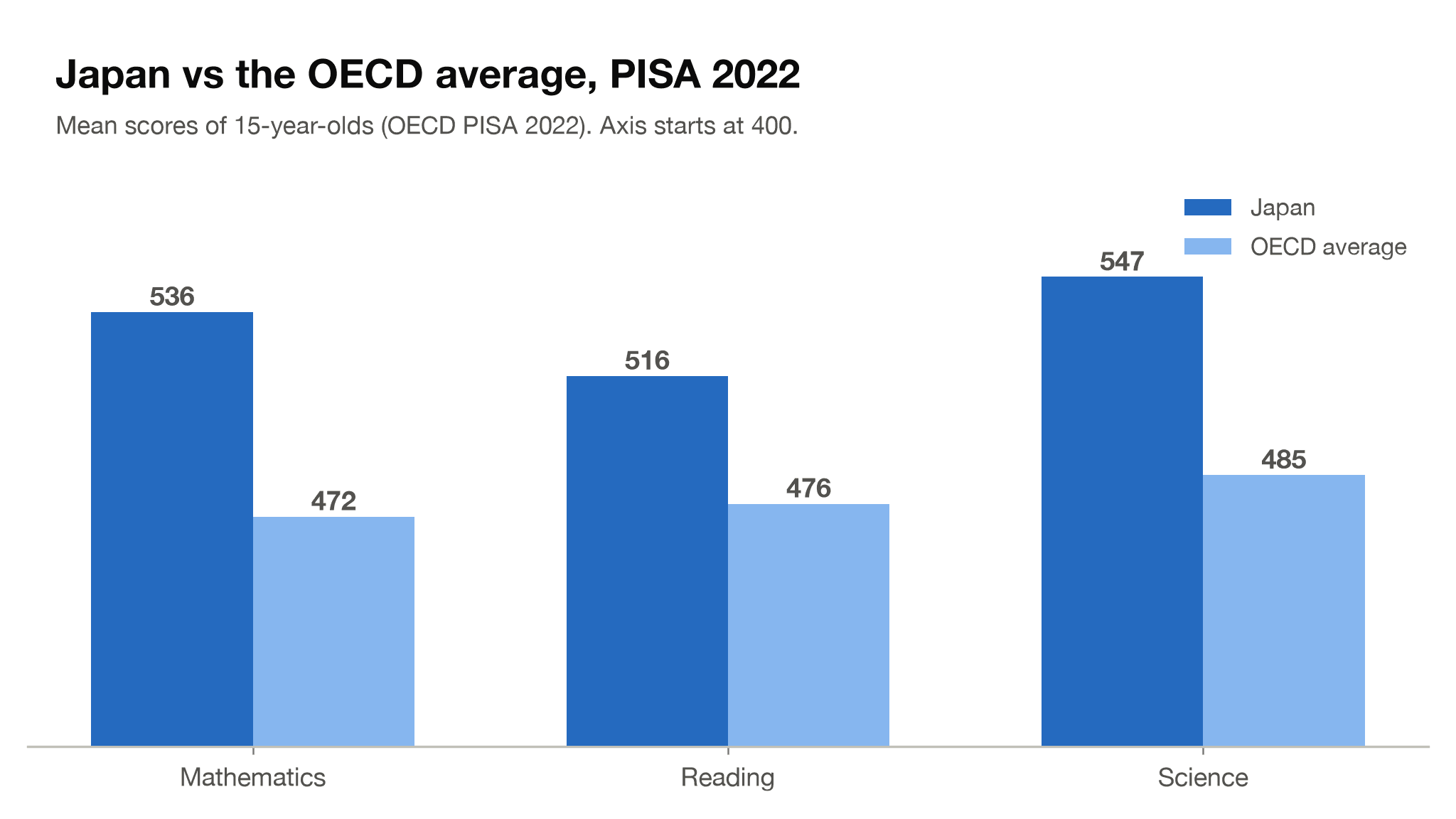
The strongest well-sampled evidence about Japanese cognitive performance comes from PISA, the OECD assessment of 15-year-olds. In PISA 2022, Japan scored 536 in mathematics, 516 in reading, and 547 in science, against OECD averages of 472, 476, and 485. That placed Japan first among 37 OECD countries in mathematics and science and second in reading, and the OECD noted the results were "among the highest ever measured by PISA in mathematics and science" (OECD, 2023; NIER, 2024).
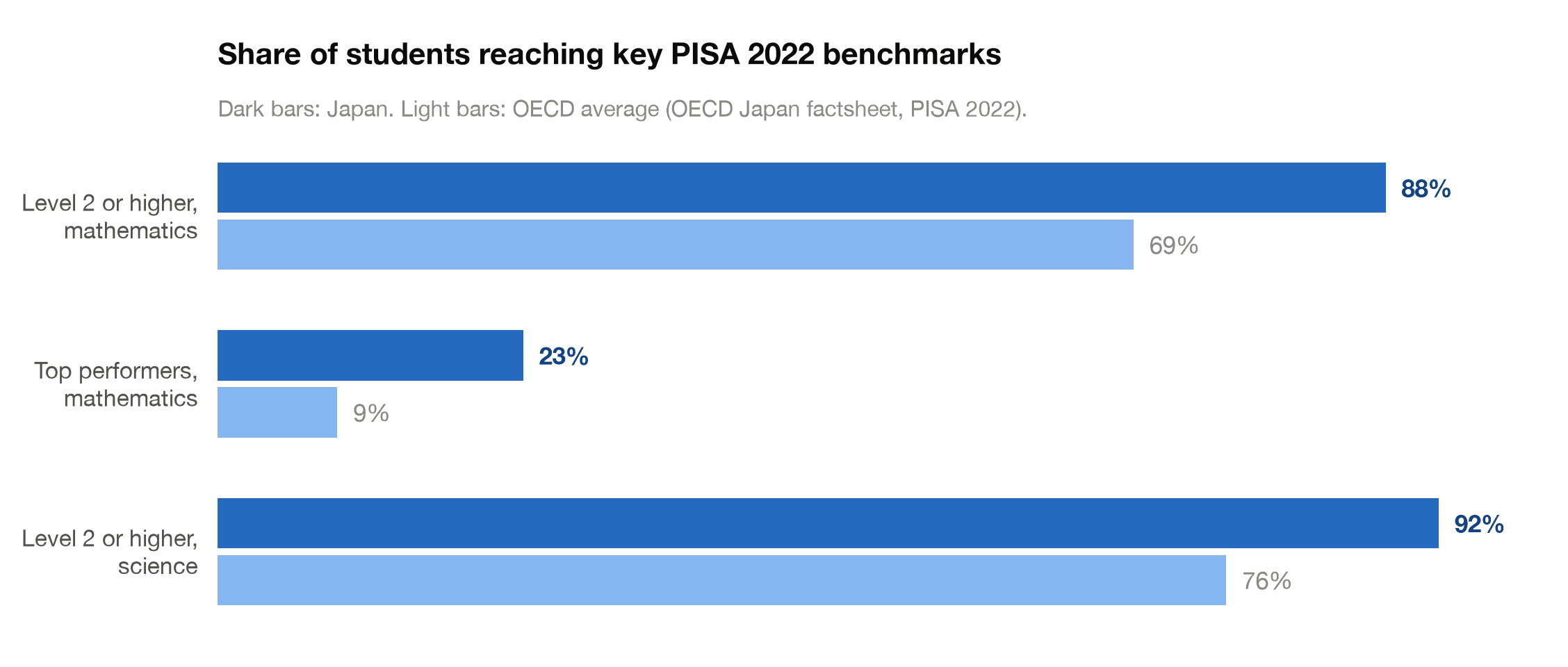
The distribution detail is just as striking. In Japan, 88 percent of students reached at least Level 2 proficiency in mathematics against an OECD average of 69 percent, 23 percent qualified as top performers in mathematics against 9 percent, and 92 percent reached Level 2 or higher in science against 76 percent. PISA is an achievement assessment of students rather than an IQ test of a population, so it yields no "national IQ." It is simply the best-sampled cognitive evidence available, and on it Japan excels.
The Flynn effect: every estimate is time-bound
Measured IQ scores rose substantially across the 20th century wherever data exist, a phenomenon James Flynn documented across 14 nations (Flynn, 1987). Lynn's own 1982 abstract reported that the measured Japan-US disparity had increased during the twentieth century. Both observations cut the same way: a figure derived from a 1975 standardization describes 1975. Treating it as a live fact about Japan today ignores five decades of the very drift the original paper reported.
What a national average does not tell you
Even a perfectly measured national mean would say little about individuals. Variation within any country dwarfs the differences between national averages, and Japan's distribution, like every country's, spans the full range of ability. The same caveats apply to Japan's neighbors; see our article on the average IQ in China for a parallel case.
Frequently asked questions
What is the average IQ in Japan?
On Japanese norms it is exactly 100, because the Japanese standardizations of the WISC-V and WAIS-IV define the national average as 100. The 105 to 107 figures online come from cross-national compilations that carry serious methodological caveats.
Is Japan the smartest country in the world?
No single number can settle that, but Japan is unambiguously among the strongest performers on well-run international assessments, ranking first among OECD countries in PISA 2022 mathematics and science and second in reading.
Where does the claim of a 105-plus Japanese IQ come from?
Mostly from Richard Lynn's compilations, starting with his 1982 Nature analysis. Stevenson and Azuma challenged that analysis in Nature the following year, and later tables built on this style of evidence have been repeatedly criticized for sampling and norm problems.
Do Japanese people take the same IQ tests as Americans?
They take Japanese adaptations. Nihon Bunka Kagakusha publishes the official Japanese Wechsler editions, each standardized on Japanese samples, which is why a 100 in Tokyo means typical for Japan.
Has the average IQ in Japan changed over time?
Measured scores rose across the 20th century, consistent with the Flynn effect. Even Lynn's 1982 paper reported that the measured Japan-US gap had grown during the century, which is why any single estimate is tied to its era.
The takeaway
Japan's strong cognitive performance is real and shows up in every well-run assessment. The precise "national IQ" numbers attached to it are artifacts of comparison method and era, which is why this article quotes them with caveats instead of certainty. Trust norms and well-sampled assessments over ranking tables. And if you want your own score on a modern norm, the Reasoning and Intelligence Online Test from RIOT IQ reports properly normed scores, starting with the free RIOT IQ test.
References
1. Lynn, R. (1982). IQ in Japan and the United States shows a growing disparity. Nature, 297, 222-223. doi.org
2. Stevenson, H. W., & Azuma, H. (1983). IQ in Japan and the United States. Nature, 306, 291-292. doi.org
3. Flynn, J. R. (1987). Massive IQ gains in 14 nations: What IQ tests really measure. Psychological Bulletin, 101(2), 171-191. doi.org
5. National Institute for Educational Policy Research (NIER), MEXT. (2024). Key features of OECD Programme for International Student Assessment 2022 (PISA 2022).nier.go.jp
6. Nihon Bunka Kagakusha. (n.d.). WISC-V [Japanese edition of the Wechsler Intelligence Scale for Children, Fifth Edition].nichibun.co.jp
7. Nihon Bunka Kagakusha. (2018). WAIS-IV [Japanese edition of the Wechsler Adult Intelligence Scale, Fourth Edition].nichibun.co.jp