What is the average IQ of engineers? Occupational studies place engineers near the top, around 110 to 120, with strong math and spatial ability profiles.
Dr. Russell T. WarneChief Scientist
Share
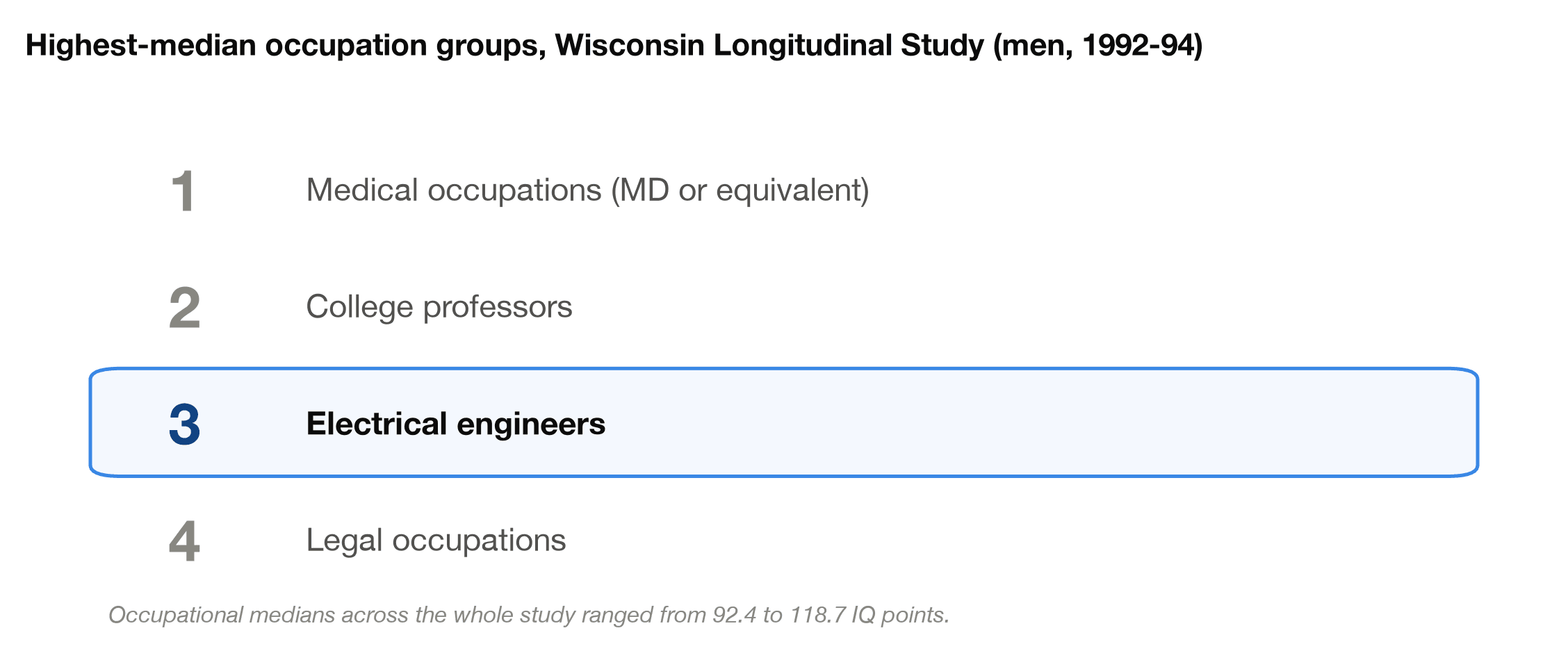
Occupational studies place engineers roughly in the 110 to 120 range as a group, near the very top of every credible dataset. In the Wisconsin Longitudinal Study, electrical engineers had the third-highest median IQ of any occupation group, behind only physicians and college professors, and the classic 1945 Army testing study put engineers among the top three of 74 civilian occupations. Averages describe groups, though. Individual engineers span a wide range of scores, and no dataset supports a single precise number like "engineers have an IQ of 125."
What the occupational data show
The Wisconsin Longitudinal Study
The Wisconsin Longitudinal Study followed thousands of 1957 high school graduates for decades and recorded their IQ scores and careers. In the 1992-94 data for men, electrical engineers ranked third by median IQ, behind medical occupations and college professors and just ahead of legal occupations. Materials and design engineers, other engineers, and computer occupations also appeared in the top cluster. Occupational medians across the whole study ranged from 92.4 to 118.7, which places the engineer groups near the top of that range, roughly in the mid-110s.
The 1945 Army study
During World War II, Harrell and Harrell recorded the Army General Classification Test scores of 18,782 Army Air Force enlisted men grouped by their previous civilian jobs. Engineers posted one of the three highest median scores of the 74 occupations, alongside accountants and lawyers. Two cautions apply: the AGCT used a standard deviation of 20 rather than the modern 15, so its numbers are not directly comparable to today's IQs, and the authors themselves noted that professional averages may run low because "many of the best men in the profession would have been officer material."
Wonderlic thresholds for professional work
Gottfredson's analysis of Wonderlic applicant data found that an IQ of about 120, the 91st percentile, makes an applicant competitive for the most demanding jobs, and that roles requiring self-directed learning and synthesis of information correspond to IQs over about 116. Engineering-type professional roles sit in these top bands.
The engineer's cognitive profile: quantitative and spatial strength
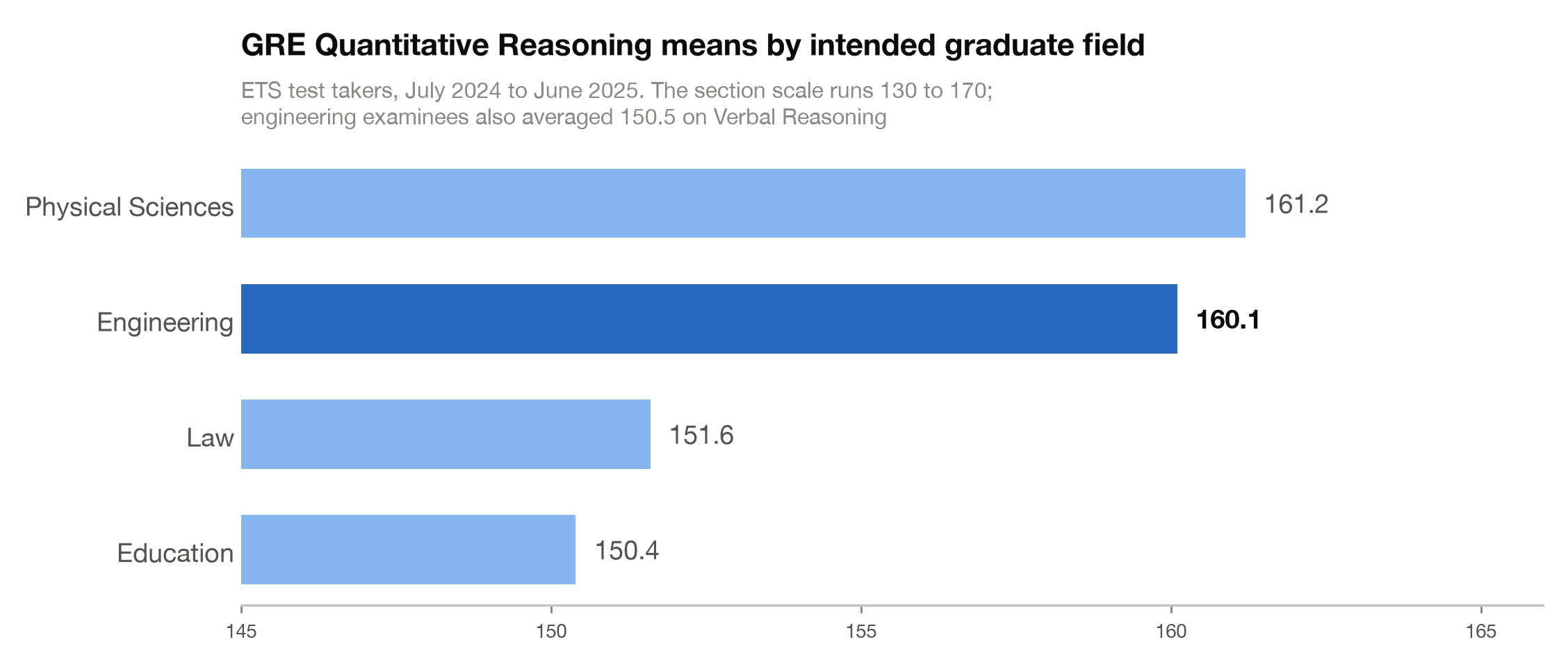
Engineers do not just score high overall. Their profile tilts hard toward quantitative and spatial reasoning. Among GRE takers from July 2024 to June 2025, examinees headed into engineering averaged 160.1 on Quantitative Reasoning, among the highest of any field, against 150.5 on Verbal Reasoning.
Spatial ability deserves its own mention. Wai, Lubinski, and Benbow reviewed more than 50 years of evidence and concluded that "spatial ability," the capacity to mentally rotate and manipulate objects, is a distinctively important predictor of success in engineering and other STEM fields, beyond what an overall score captures. This is one reason the Reasoning and Intelligence Online Test includes visuospatial subtests rather than relying on verbal and numerical items alone.
What IQ do you need to become an engineer?
There is no cutoff. The Wonderlic data suggest that scores around IQ 116 to 120 make applicants competitive for the most demanding professional roles, but Gottfredson also found that the middle 50% of applicants to a job generally covers a range of 15 to 20 IQ points, and that there is much IQ variation within all occupations and much overlap among them. Plenty of working engineers score below 110, and many score above 130. Cognitive ability predicts how easily someone gets through the math-heavy coursework and training that engineering requires, which is why the field's average lands where it does; standardized tests of reasoning predict success in quantitative graduate programs as well.
How engineers compare with other professions
At the top of the occupational ladder the gaps are small. Physicians edge out engineers on average, and engineers sit essentially beside lawyers; see our article on the average IQ of a doctor for the group that tops most datasets. The differences between these professions are minor compared with the spread inside each one. For the full occupational picture, our companion guide to the average IQ by profession covers the whole ladder, and our overview of the average IQ explains the 100-point scale these figures sit on.
Frequently asked questions
What is the average IQ of an engineer?
Occupational studies consistently place engineers in the top cluster, with group medians roughly in the 110 to 120 range. In the Wisconsin Longitudinal Study, electrical engineers had the third-highest median IQ of any occupation group.
Do engineers have higher IQs than doctors or lawyers?
On average, doctors edge out engineers, and engineers sit very close to lawyers. In the Wisconsin data the order at the top was physicians, professors, electrical engineers, then legal occupations, with small gaps and heavy overlap.
What IQ do you need to become an engineer?
There is no cutoff. Wonderlic data suggest scores around IQ 116 to 120 make applicants competitive for the most demanding professional roles, but the middle 50% of applicants to any job spans 15 to 20 IQ points.
Are engineers better at math than verbal reasoning?
As a group profile, yes. GRE takers heading into engineering average 160.1 on Quantitative Reasoning versus 150.5 on Verbal, and research shows spatial ability is a distinctively important predictor of engineering success.
Is engineering the smartest profession?
Engineering ranks near the top in every credible dataset, from the 1945 Army study to modern graduate-test data, but physicians and professors typically average slightly higher, and every profession overlaps heavily with the others.
The takeaway
Engineers average near the top of the occupational IQ distribution, with a profile that leans on quantitative and spatial reasoning, and the range within the profession is wide. If you are curious how your own profile compares, including the visuospatial abilities that matter most in engineering, the Reasoning and Intelligence Online Test measures them directly. You can start with the free IQ test from RIOT IQ.
References
1. Hauser, R. M. (2002). Meritocracy, cognitive ability, and the sources of occupational success (CDE Working Paper 98-07). University of Wisconsin-Madison. gwern.net
2. Harrell, T. W., & Harrell, M. S. (1945). Army General Classification Test scores for civilian occupations. Educational and Psychological Measurement, 5(3), 229-239. doi.org/10.1177/001316444500500303
3. Gottfredson, L. S. (1997). Why g matters: The complexity of everyday life. Intelligence, 24(1), 79-132. udel.edu
4. Educational Testing Service. (2025). A snapshot of the individuals who took the GRE General Test, July 2020-June 2025.ets.org
5. Wai, J., Lubinski, D., & Benbow, C. P. (2009). Spatial ability for STEM domains: Aligning over 50 years of cumulative psychological knowledge solidifies its importance. Journal of Educational Psychology, 101(4), 817-835. gwern.net
6. Kuncel, N. R., & Hezlett, S. A. (2007). Standardized tests predict graduate students' success. Science, 315(5815), 1080-1081. pubmed.ncbi.nlm.nih.gov
Hero image: engineers working on NASA's MAVEN spacecraft. NASA, public domain, via Wikimedia Commons.
Take our professional IQ test
Want to know your IQ? Try the first ever professional online IQ test.