What is the average IQ of lawyers? Occupational studies put attorneys near the top, around 110 to 120, and the LSAT itself works like a reasoning test.
Dr. Russell T. WarneChief Scientist
Share
As a group, lawyers average roughly 110 to 120 on the IQ scale. Legal occupations had the fourth-highest median IQ of any occupation group in the Wisconsin Longitudinal Study, and lawyers ranked second among 74 civilian occupations in the classic 1945 Army testing study. Individual attorneys span a wide range, and no precise "lawyer IQ" number survives scrutiny, but the pattern is consistent: the profession selects for reasoning ability at every gate, starting with the LSAT.
What the occupational data show
The Wisconsin Longitudinal Study
The Wisconsin Longitudinal Study, which followed 1957 high school graduates through their careers, found that legal occupations had the fourth-highest median IQ among men measured in 1992-94, behind medical occupations, college professors, and electrical engineers. Occupational medians across the study ranged from 92.4 to 118.7, which puts the legal group near the top of that range, roughly in the mid-110s.
The 1945 Army study
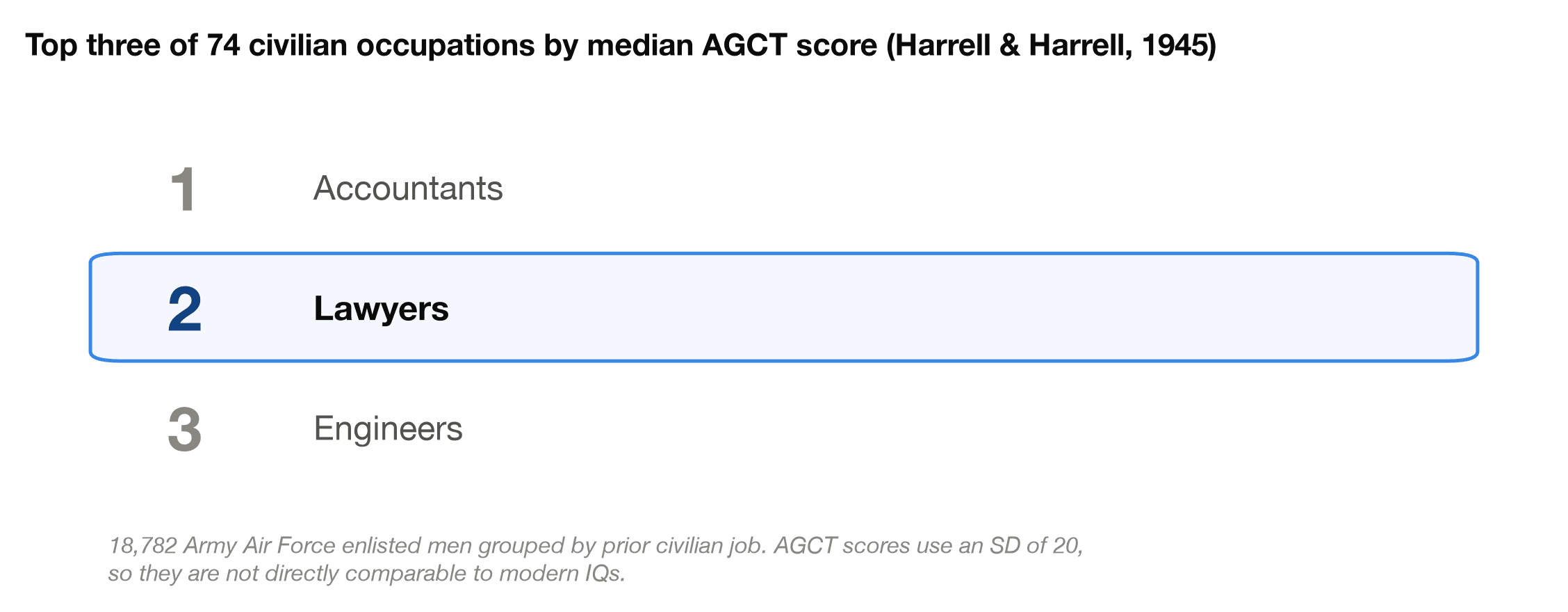
Harrell and Harrell's wartime dataset of 18,782 Army Air Force enlisted men, grouped by prior civilian occupation, ranked lawyers second of 74 occupations by median score, between accountants and engineers. The AGCT scale used a standard deviation of 20 rather than the modern 15, so its raw numbers overstate differences in today's terms, and the authors cautioned that professional averages may run low because "many of the best men in the profession would have been officer material."
Wonderlic thresholds for elite professional work
Gottfredson's analysis of Wonderlic applicant data found that an IQ of about 120 makes an applicant competitive for the highest-level jobs, and that work built on gathering and synthesizing information corresponds to IQs over about 116. Attorney-level work sits squarely in these bands.
The LSAT connection: a reasoning test in disguise
Law is unusual among professions in that its main entrance exam looks a great deal like a cognitive ability test. The LSAT is scored on a scale from 120 to 180, converts raw correct answers to that scale, and applies no deduction for wrong answers. Its content is logical reasoning and dense reading comprehension, exactly the kind of material that makes a test "g-loaded," meaning strongly related to general intelligence. Frey and Detterman found the SAT, a similar reasoning-heavy test, correlates .82 with general cognitive ability, and meta-analytic work by Kuncel and Hezlett shows the major admissions tests, the LSAT among them, predict later academic success.
American Mensa treats the LSAT accordingly: it accepts an LSAT taken after 1982 at the 95th percentile as qualifying evidence for membership, which is otherwise reserved for the top 2% of the population. Note the fine print: that bar is the 95th percentile of LSAT takers, an already selected, above-average group, rather than of the general population. No verified study publishes an exact LSAT-to-IQ conversion, so treat any such formula you see online as invented.
Do you need a high IQ to practice law?
No cutoff exists. The profession's gates, the LSAT, law school exams, and the bar exam, are all reasoning-heavy, so people who clear them tend to score well, and that selection is what the occupational averages reflect. But Gottfredson's data show the middle 50% of applicants to any job spans 15 to 20 IQ points, with much variation within every occupation and much overlap among them. Many practicing lawyers score below 110, many score above 130, and success in practice depends on preparation, judgment, and work habits as well as raw reasoning.
Lawyers compared with doctors, engineers, and CEOs
At the top of the occupational ladder, the gaps are small and the distributions overlap heavily. Physicians average slightly higher than lawyers; see our article on the average IQ of a doctor for that comparison, and our guide to the average IQ by profession for the whole ladder. Executives are a different case: leadership roles draw from a broad range, as our article on the IQ of CEOs explains. The honest summary is that lawyers belong to a top cluster of professions separated from one another by a few points at most.
Frequently asked questions
What is the average IQ of a lawyer?
Occupational studies place lawyers roughly in the 110 to 120 range as a group. Legal occupations ranked fourth in the Wisconsin Longitudinal Study, and lawyers ranked second of 74 occupations in the 1945 Army study.
Are lawyers smarter than doctors?
On average, physicians score slightly higher. In the Wisconsin data the top of the ranking ran physicians, college professors, electrical engineers, then legal occupations, with gaps that are small compared to the variation inside each profession.
Is the LSAT an IQ test?
Not officially, but it behaves like one in important ways. It is a standardized reasoning test scored from 120 to 180, it predicts law school success, and American Mensa accepts a 95th percentile LSAT taken after 1982 as qualifying evidence.
What LSAT score corresponds to a high IQ?
There is no official conversion, and no verified study publishes an LSAT-to-IQ formula. As a benchmark, Mensa treats the 95th percentile of LSAT takers as evidence of top-2% ability, since test takers are already a selected group.
Do you need a high IQ to become a lawyer?
There is no cutoff. Reasoning-heavy gates like the LSAT and bar exam mean successful entrants tend to score well, but the middle 50% of applicants to any occupation spans 15 to 20 IQ points, so practicing lawyers cover a wide range.
The takeaway
Lawyers average near the top of the occupational IQ distribution because the path into law runs through a series of reasoning tests, and that is evidence that cognitive ability matters for demanding work, not that a particular score is required for it. If you would like a real measure of your own reasoning rather than a folk estimate, the Reasoning and Intelligence Online Test reports a properly normed score with stated precision. You can start with the free IQ test from RIOT IQ.
References
1. Hauser, R. M. (2002). Meritocracy, cognitive ability, and the sources of occupational success (CDE Working Paper 98-07). University of Wisconsin-Madison. gwern.net
2. Harrell, T. W., & Harrell, M. S. (1945). Army General Classification Test scores for civilian occupations. Educational and Psychological Measurement, 5(3), 229-239. doi.org/10.1177/001316444500500303
3. Gottfredson, L. S. (1997). Why g matters: The complexity of everyday life. Intelligence, 24(1), 79-132. udel.edu
4. Law School Admission Council. (2026). LSAT scoring.lsac.org
5. American Mensa. (2026). Qualifying test scores.us.mensa.org
6. Kuncel, N. R., & Hezlett, S. A. (2007). Standardized tests predict graduate students' success. Science, 315(5815), 1080-1081. pubmed.ncbi.nlm.nih.gov
7. Frey, M. C., & Detterman, D. K. (2004). Scholastic Assessment or g? The relationship between the Scholastic Assessment Test and general cognitive ability. Psychological Science, 15(6), 373-378. pubmed.ncbi.nlm.nih.gov
Hero image: a prosecutor argues a motion at the Hennepin County District Court. Photo: Tony Webster, CC BY 2.0, via Wikimedia Commons.
Take our professional IQ test
Want to know your IQ? Try the first ever professional online IQ test.